Samsung Ice Maker Not Working – Fix It Fast
Last reviewed by Jabeer: September 5, 2026.
Record these details before resetting anything
- The full model code from the label inside the refrigerator compartment
- Whether the freezer is holding its normal food-safe temperature
- Whether the water dispenser has normal flow
- Whether the ice bucket is empty, jammed, or frozen in place
- Any error code shown on the display
1. Ice Maker Is Turned Off or in Demo Mode
Samsung refrigerators have a dedicated ice maker on/off button, and demo (showroom) mode disables cooling and ice production entirely. This is the quickest fix to rule out before touching anything else.
- Locate the ice maker power switch inside the freezer compartment or on the control panel and confirm it is in the ON position.
- Check the display for “OF OF,” “O FF,” or a demo-mode indicator. To exit, press and hold Energy Saver + Fridge simultaneously for 3–5 seconds (exact buttons vary by model—see your manual).
- Confirm the child lock is not active; hold the Lock button for 3 seconds to deactivate it.
- Allow 24 hours for the ice maker to begin a new production cycle after enabling it.
2. Freezer Temperature Is Too Warm
Samsung recommends a freezer temperature of 0 °F (−18 °C) for optimal ice production; anything above 10 °F will slow or stop ice making. Fluctuating temps can also indicate a cooling problem upstream.
- Press the Freezer button on the control panel and set the target temperature to 0 °F (−18 °C).
- Place a thermometer in the freezer for two hours to verify the actual temperature matches the set point.
- Make sure the freezer is not overpacked; airflow around the ice maker assembly is essential.
- Inspect the door gasket for tears or gaps that let warm air in (see Cause 3 below).
- If the freezer cannot reach 0 °F, the evaporator fan or sealed system may be at fault—proceed to Cause 6.
3. Door Gasket Is Damaged or Dirty
A worn or dirty door seal allows warm, humid air to enter the freezer, causing frost buildup on the ice maker components and inconsistent temperatures. Replacing a gasket is an inexpensive DIY fix.
- Close the freezer door on a single sheet of paper; if it slides out easily, the seal is inadequate.
- Clean the gasket thoroughly with warm soapy water and a soft brush, removing any food debris or mildew.
- Inspect the full perimeter for cracks, tears, or sections that no longer spring back when pressed.
- If damaged, order a replacement gasket matched to your refrigerator model and press the new gasket into the door channel, working from the corners inward.
4. Water Supply Line Is Kinked, Frozen, or Shut Off
The ice maker needs a continuous supply of water at adequate pressure (20–120 psi); a closed valve, kinked line, or ice blockage inside the fill tube will stop production immediately. This is one of the most common reasons a samsung ice maker not working call comes in.
- Pull the refrigerator away from the wall and trace the water supply line to the shutoff valve under the sink or behind the unit; confirm the valve is fully open.
- Inspect the line for kinks or pinches and straighten as needed.
- Remove the ice maker cover inside the freezer and look for ice blocking the fill tube (the small tube that drips water into the tray). Use a hair dryer on low heat to thaw any blockage.
- Dispense water from the door dispenser; if water flow is slow or absent, the issue is definitely supply-side.
- Consider replacing a plastic supply line with a braided stainless steel line to prevent future kinks.
5. Water Inlet Valve Is Faulty
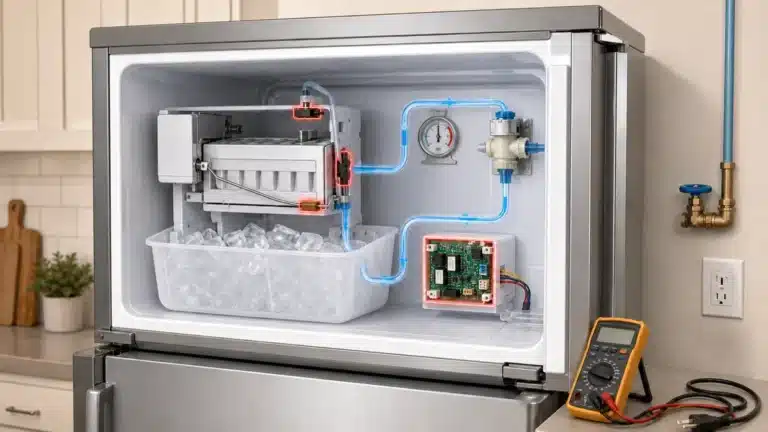
The water inlet valve is a solenoid-operated valve that opens to let water into the ice maker; if its solenoid coil fails or the valve body clogs with mineral deposits, no water reaches the ice mold. Testing it with a multimeter confirms failure quickly.
- Unplug the refrigerator before starting any electrical work.
- Pull the fridge away from the wall and remove the rear lower access panel to expose the water inlet valve.
- Disconnect the water lines and electrical connectors from the valve, noting their positions or taking a photo.
- Set a multimeter to Ω (resistance) and probe the solenoid terminals. A healthy solenoid typically reads 200–500 Ω; an open-circuit (OL) reading indicates a failed coil.
- Inspect the valve’s mesh filter screen for sediment and clean it with a soft brush; if the screen is severely clogged or the coil tests bad, replace the valve.
- Reconnect lines and connectors on the new valve, restore power, and allow a full cycle to confirm ice production resumes.
6. Ice Maker Assembly or Ice Maker Control Board Is Defective
If all water supply and temperature checks pass, the ice maker module itself—its motor, thermostat, or onboard control board—may have failed. Samsung’s Twin Cooling Plus and French-door models are particularly prone to ice maker assembly failures covered under extended warranty programs.
- Perform a forced diagnostic test: open the freezer, locate the small test button (marked with an arrow or “TEST”) on the ice maker module, and press and hold it for 3 seconds until you hear a chime. The ice maker should run through a complete harvest cycle in about 6 minutes.
- If the harvest motor does not turn, the ice maker module has likely failed.
- Check Samsung’s official support page for any active service bulletins or warranty extensions for your model at samsung.com/us/support/refrigerators.
- If no warranty coverage applies, replace the entire ice maker assembly as a unit—individual internal components are not sold separately by Samsung.
- After installing the new assembly, run two or three ice batches and discard them to flush the system before using the ice.
Frequently asked questions
How long does it take a Samsung ice maker to make ice after a reset?
After a reset or initial power-up, expect the first batch of ice in approximately 6–12 hours. Full production capacity—roughly 4–5 pounds per day on most models—is typically reached within 24 hours once the freezer is at 0 °F (−18 °C).
How do I reset a Samsung ice maker?
Press and hold the Test button on the ice maker module (the small button on the side or front of the assembly, sometimes behind the ice bucket) for 3–5 seconds until you hear a chime. The unit will run a full harvest cycle, effectively resetting the control logic. Always ensure the ice bucket is replaced before running a cycle.
Why is my Samsung ice maker making small, hollow, or misshapen ice?
Low water pressure (below 20 psi) or a partially clogged water inlet valve restricts water flow into the mold, producing undersized or hollow cubes. Replace the refrigerator water filter if it is more than six months old, and verify household water pressure at the supply valve.
Is there a known defect with Samsung ice makers?
Yes. Samsung has faced class-action litigation and issued technical service bulletins regarding ice maker failures—particularly ice buildup around the evaporator in French-door models. Some units qualify for free repairs or extended warranty coverage. Visit Samsung’s official support site and enter your model number to check for any active programs before spending money on parts.