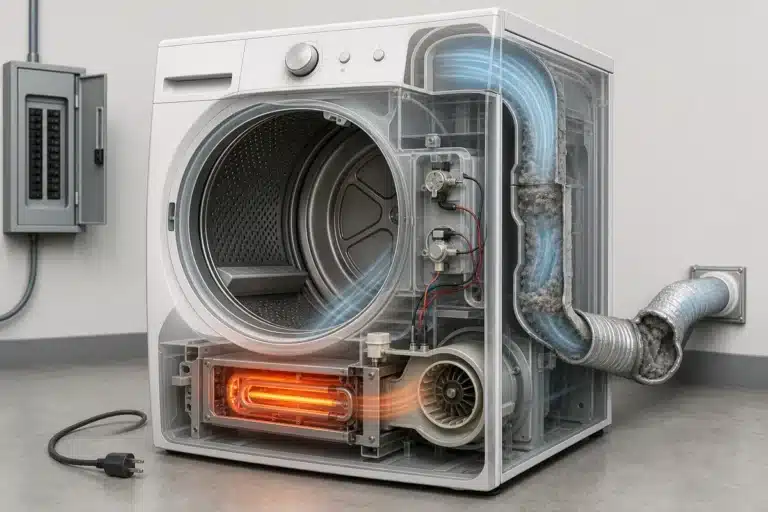
Dryer Not Heating? Causes & Fixes (Step-by-Step)
Last reviewed by Jabeer: September 5, 2026.
Match the symptom before testing parts
| Symptom | Check first |
|---|---|
| Drum turns, no heat | Breaker, vent restriction, thermal fuse, then heater or gas ignition parts |
| Heat starts, then fades | Lint screen, crushed vent, exterior vent flap, cycling thermostat |
| Dryer will not start | Power, door switch, start switch; this is not only a heating fault |
| Burning smell or scorching | Stop using the dryer and inspect the plug, cord, terminal block, and lint path |
1. Tripped Circuit Breaker or Blown House Fuse
Electric dryers run on a double-pole 240 V breaker; if one leg trips, the drum may still spin but the heater loses power entirely. This is the quickest, free fix to check first.
- Go to your home’s electrical panel and locate the dryer breaker (usually 30 A, double-pole).
- If it is in the middle or “OFF” position, firmly switch it fully OFF, then back ON.
- Run the dryer on a timed heat cycle for 5–10 minutes and check for warmth.
- If the breaker trips again immediately, stop using the dryer and call an electrician—there is a deeper electrical fault.
2. Blown Thermal Fuse (Most Common Cause of a Dryer Not Heating)
The thermal fuse is a one-shot safety device mounted on the exhaust duct or burner housing; once it blows from overheating, it cuts power to the heater permanently and must be replaced.
- Unplug the dryer from the wall outlet before doing any work.
- Remove the back panel (usually 4–8 screws) to access the exhaust duct area.
- Locate the small, oblong thermal fuse—typically white or silver plastic with two wires.
- Set a multimeter to continuity mode and probe both terminals of the fuse.
- No beep (open circuit) = blown fuse. A good fuse will beep continuously.
- Disconnect the wires, remove the single mounting screw, and swap in the new fuse.
- Important: also clean the exhaust duct before restarting—a clogged vent caused the fuse to blow.
3. Clogged Exhaust Vent or Lint Screen
Restricted airflow causes the dryer to overheat, repeatedly blow thermal fuses, and run without producing useful heat. Clearing the vent is free and often solves repeat heating failures.
- Pull the lint screen out and remove all accumulated lint; rinse the screen with warm water if it resists airflow.
- Disconnect the flexible duct from the back of the dryer and inspect it for lint blockages or kinks.
- Use a dryer vent brush kit to clean the full length of the duct from inside and from the exterior wall cap.
- Confirm the exterior wall flap opens freely when you run the dryer.
- Duct runs longer than 25 feet (accounting for elbows) should be shortened or upgraded to rigid metal duct.
4. Failed Heating Element (Electric Dryers)
The heating element is a coiled wire that generates heat; a single break in the coil stops all heat production while the drum continues to turn normally.
- Unplug the dryer and remove the back or front panel to expose the element housing (consult your model’s service diagram).
- Visually inspect the coil for a visible break, burn mark, or sagging section.
- Set a multimeter to resistance (ohms) and probe the two element terminals—a good element reads roughly 8–50 Ω depending on wattage; an open reading (OL/infinite) means it has failed.
- Disconnect the wires and remove the element mounting screws or bracket.
- Install the new element, reconnect the wires, reassemble, and test on a timed heat cycle.
5. Faulty High-Limit Thermostat or Cycling Thermostat
Dryers use two or more thermostats to regulate temperature; a failed thermostat can prevent the heater from ever switching on, or cause it to shut off prematurely.
- Unplug the dryer and locate the thermostats on the heater housing or blower duct—they are small disc-shaped components with two terminals each.
- Test each thermostat for continuity at room temperature; a functioning thermostat should show continuity (closed circuit) when cold.
- Replace any thermostat that reads open (no continuity) at room temperature.
- Thermostats are inexpensive and are often sold as a kit; replacing all of them at once is cost-effective.
6. Defective Gas Valve Coils or Igniter (Gas Dryers Only)
Gas dryers rely on an igniter to light the burner and solenoid coils on the gas valve to release gas; if either part fails, the burner will not light and the dryer produces no heat.
- Unplug the dryer and shut off the gas supply valve behind the unit before opening any panels.
- Remove the front panel or lower access panel to view the burner assembly.
- Start the dryer briefly (with panels off and a helper watching) to see if the igniter glows orange. If it glows but the flame never lights, the gas valve coils are likely failed.
- Test the igniter for continuity; a broken igniter will read open (no continuity) and must be replaced.
- Gas valve coil kits are sold as a set—replace all coils at once since they fail together.
- If you smell gas at any point, stop immediately, ventilate the area, and call your gas utility.
Frequently asked questions
How do I know if my thermal fuse is blown without a multimeter?
Without a meter, the only reliable method is substitution—swap in a new thermal fuse (they cost just a few dollars) and see if heat returns. However, a basic continuity tester or inexpensive multimeter is strongly recommended so you can confirm the diagnosis before buying parts and to test other components like thermostats and the heating element.
Can I bypass the thermal fuse to test my dryer?
Technically you can jumper the fuse terminals temporarily for a diagnostic test, but you should never operate the dryer in bypass mode beyond a brief test. The thermal fuse is a critical fire-safety device. If it is bypassed and the root cause (usually a blocked vent) is not fixed, the dryer can overheat and become a fire hazard. Always replace the fuse and fix the underlying cause.
Why does my dryer heat for a little while and then stop?
Intermittent heat almost always points to a partially clogged exhaust vent or a faulty cycling thermostat. Restricted airflow causes the dryer to overheat, tripping the high-limit thermostat, which shuts off the heater until the dryer cools down—then the cycle repeats. Clean the vent thoroughly first; if the problem continues, test and replace the cycling thermostat.
Where can I find the official service information for my specific dryer model?
The best starting point is the manufacturer’s own support website. For general appliance repair guidance and official use-and-care manuals, visit the U.S. Department of Energy’s appliance resource page, then search your dryer brand’s official support portal using the full model number found on the door-jamb label inside the dryer door.