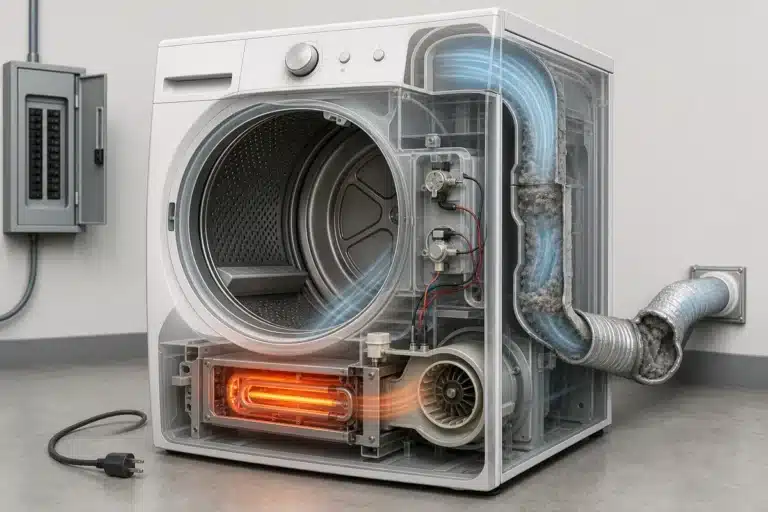
Whirlpool Cabrio Dryer Not Heating – Fix It Fast

Quick answer: A whirlpool cabrio dryer not heating is most often caused by a blown thermal fuse, a failed heating element, or a tripped circuit breaker — all of which you can diagnose at home with a multimeter and basic tools in under an hour.

How to fix a Whirlpool Cabrio dryer not heating: causes ranked easiest first

1. Tripped or blown circuit breaker

Electric dryers use two legs of 240 V power. If one breaker leg trips, the drum may spin but the heating element gets no power — making the dryer run cold.

  1. Locate your home’s electrical panel and find the double-pole breaker labeled for the dryer.
  2. If either side appears tripped (middle position) or you’re unsure, switch it fully OFF, then firmly back ON.
  3. Run a timed dry cycle and check for heat. If the breaker trips again immediately, stop and call an electrician — a wiring fault exists.

2. Clogged lint filter or exhaust vent

A restricted airflow path causes the dryer to overheat, trip its high-limit thermostat, and shut off heat as a safety measure. This is one of the most overlooked causes of a no-heat complaint.

  1. Pull out the lint filter and clean it thoroughly under running water if it is coated with fabric-softener residue; let it dry completely before reinserting.
  2. Disconnect the exhaust duct from the back of the dryer and inspect it for lint blockages, kinks, or crushed sections.
  3. Use a dryer vent cleaning brush kit to clear the full length of the duct run all the way to the exterior wall cap.
  4. Confirm the exterior vent flap opens freely when the dryer runs.
  5. Restore connections and run a test cycle.

3. Blown thermal fuse

The thermal fuse is a one-shot safety device located on the exhaust duct inside the dryer cabinet. Once it blows — usually from overheating caused by a clogged vent — it cuts power to the heating circuit permanently until replaced.

  1. Unplug the dryer from the wall outlet before opening the cabinet.
  2. Remove the back panel (typically 8–10 Phillips screws) to access the exhaust duct housing near the bottom.
  3. Disconnect the two wire connectors from the thermal fuse.
  4. Set a multimeter to continuity mode and probe both terminals of the fuse. A good fuse will beep; no continuity means it is blown.
  5. Replace the fuse with the correct thermal fuse for your Cabrio model. Important: also clear the vent before restarting, or the new fuse will blow again.
Part needed: Thermal fuse — a small, one-use safety component mounted on the exhaust duct housing.
Check price

4. Failed heating element

The heating element is a coiled resistance wire that generates heat inside the element housing. If any part of the coil breaks, the circuit opens and the dryer produces no heat at all.

  1. Unplug the dryer and remove the back panel.
  2. Locate the large cylindrical or rectangular element housing on the lower rear of the drum.
  3. Disconnect all wire connectors from the element terminals.
  4. Test across the two main terminals with a multimeter set to continuity. No continuity indicates a broken coil.
  5. Visually inspect for a visible break or burnt spot in the coil as confirmation.
  6. Install the replacement heating element, reconnect the wiring, and reassemble the panel.
Part needed: Heating element assembly — the coiled resistance wire and housing that generates drying heat.
Check price

5. Defective cycling thermostat or high-limit thermostat

The cycling thermostat regulates operating temperature by cycling the heater on and off; the high-limit thermostat acts as a secondary safety cutoff. Either can fail in an open position, permanently disabling the heat circuit.

  1. Unplug the dryer and remove the back panel.
  2. Locate the thermostats — typically small disc-shaped components clipped to the exhaust duct or element housing.
  3. Disconnect the wires from each thermostat and test for continuity individually. A good thermostat at room temperature should show continuity.
  4. Replace any thermostat that shows no continuity.
  5. Note: thermostats are often sold as a kit; replacing both at once is good practice.
Part needed: Cycling thermostat — regulates heat cycling during normal operation.
Check price
Part needed: High-limit thermostat — secondary safety cutoff mounted near the heating element.
Check price

6. Faulty igniter or gas valve coils (gas models only)

On Cabrio gas dryers, a cracked igniter or failed gas valve solenoid coils will prevent the burner from lighting, resulting in tumbling without any heat.

  1. Unplug the dryer and shut off the gas supply valve behind the unit.
  2. Remove the front panel and lower access panel to expose the burner assembly.
  3. Visually inspect the igniter for cracks or breaks; test it with a multimeter for continuity (a good igniter typically reads 50–400 ohms).
  4. If the igniter glows but the burner still doesn’t light, the gas valve coils are the likely culprit. Test each coil for continuity; failed coils read open.
  5. Replace the igniter or the gas valve coil kit as needed.
  6. Restore gas supply, plug in the dryer, and run a full cycle to confirm heat.
Part needed: Dryer igniter — the glow-type igniter that lights the gas burner.
Check price
Part needed: Gas valve coil kit — the solenoid coils that open the gas valve to allow fuel flow.
Check price

For model-specific wiring diagrams and official guidance, visit the Whirlpool official support page.

Still stuck or prefer a pro? Find a local technician

Frequently asked questions

Why does my Whirlpool Cabrio dryer run but produce no heat?

The most common reasons are a blown thermal fuse, a failed heating element (electric models), or a broken igniter (gas models). Start by checking your home circuit breaker, then test the thermal fuse with a multimeter — it’s the least expensive part and fails most often.

Can I run my Cabrio dryer with a blown thermal fuse replaced but without clearing the vent?

You can, but the new fuse will almost certainly blow again within a short time. The thermal fuse trips because of overheating, and overheating is almost always caused by restricted airflow. Always clear the full vent run before or immediately after replacing the fuse.

How do I know if my Cabrio has a gas or electric heating system?

Check the power connection at the wall: an electric dryer uses a large 240 V outlet with a 3- or 4-prong plug, while a gas dryer uses a standard 120 V outlet and has a flexible gas supply line connected to the back. Your model number (found inside the door frame) will also specify “gas” or “electric.”

Is it safe to replace a thermal fuse or heating element myself?

Yes, for most DIY-comfortable homeowners. Always unplug the dryer from the wall before opening the cabinet, and for gas models also shut off the gas supply valve. These are straightforward component swaps requiring only a screwdriver and multimeter. If you are uncomfortable working around electrical components or gas connections, hire a qualified appliance technician.

Related problems

See all Dryer guides →

Similar Posts

Leave a Reply

Your email address will not be published. Required fields are marked *