Whirlpool Freezer Not Freezing: 6 Checks
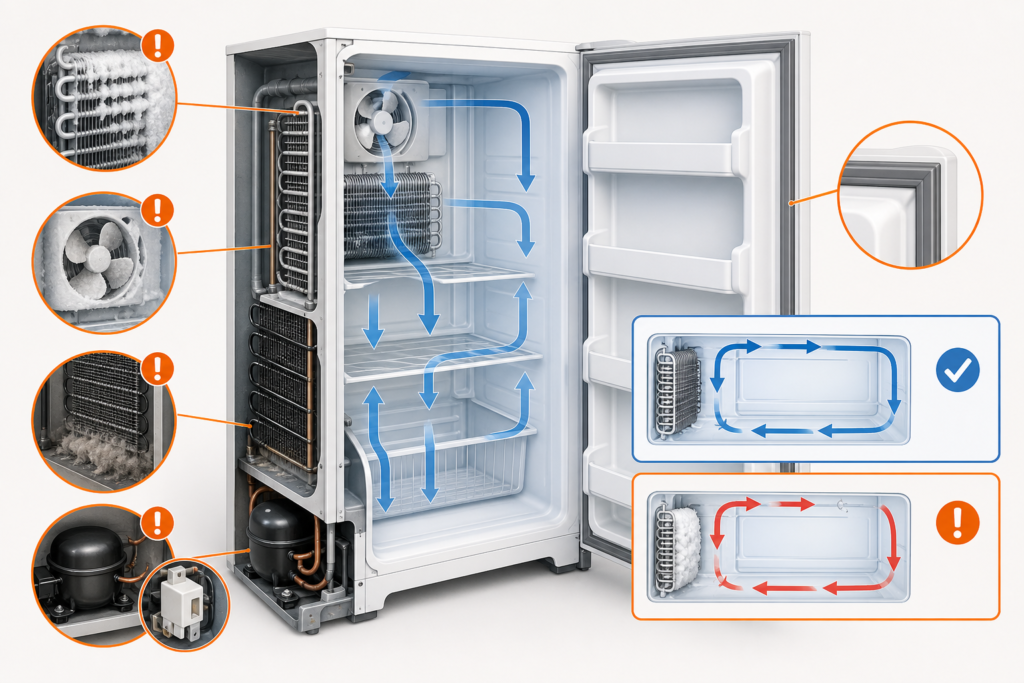
Choose the first check from the symptom
| Symptom | Start here |
|---|---|
| Freezer has power but temperature is above 0°F (-18°C) | Control setting, door seal, blocked vents and recent loading |
| Back wall has heavy frost | Move food to safe storage and arrange defrost-system diagnosis if frost quickly returns |
| Fan noise stops when cooling is expected | Clear blocked vents; use service for fan access or replacement |
| Compressor clicks repeatedly | Stop repeated resets and arrange professional diagnosis |
Food safety: Move food to another freezer or an ice-filled cooler if it is thawing. Do not rely on appearance alone to decide whether thawed food is safe.
1. Incorrect Temperature Setting
Someone may have accidentally bumped the temperature dial, or a power flicker may have reset the control. The freezer should be set to 0 °F (−18 °C) to maintain a solid freeze.
- Locate the temperature control dial or digital panel inside the freezer compartment.
- Set the temperature to 0 °F (−18 °C) or the manufacturer’s recommended setting.
- Wait 24 hours for the compartment to stabilize, then check with a reliable appliance thermometer.
- If the display is unresponsive, unplug the freezer for 60 seconds to reset the control board, then replug and reset the temperature.
2. Dirty or Blocked Condenser Coils
Condenser coils release heat from the refrigerant; when they are coated in dust and debris, the freezer cannot cool efficiently. This is one of the most overlooked causes of a Whirlpool freezer not freezing properly.
- Unplug the freezer from the wall outlet.
- Pull the unit away from the wall and locate the condenser coils—typically behind a rear access panel or along the bottom front behind a grille.
- Use a coil-cleaning brush and a vacuum with a brush attachment to remove dust and pet hair.
- Ensure there is at least 2 inches of clearance on all sides for proper airflow.
- Plug the unit back in and monitor temperature over the next several hours.
3. Evaporator Fan Motor Failure
The evaporator fan circulates cold air throughout the freezer; if it stops running, temperatures will rise even though the compressor is working. You will often notice the freezer is warm but the compressor is humming.
- Open the freezer door and listen for the fan running—it should be audible within a few seconds of opening.
- Unplug the freezer and remove the interior back panel (usually held by a few screws) to access the evaporator fan.
- Spin the fan blade by hand; if it is stiff or the motor makes no sound when power is applied, the motor has likely failed.
- Check for ice buildup around the fan that may be blocking the blade; if present, defrost manually (see cause #4 below) before replacing the motor.
- Replace the evaporator fan motor if it does not run freely or fails a continuity test with a multimeter.
4. Frost Buildup on Evaporator Coils (Defrost System Failure)
If the automatic defrost system fails—due to a bad defrost heater, defrost thermostat, or defrost timer—ice accumulates on the evaporator coils and blocks airflow entirely. This causes the freezer to warm up gradually over several days.
- Unplug the freezer and remove all food, storing it in a cooler with ice.
- Remove the interior back panel to inspect the evaporator coils for heavy frost or solid ice.
- If heavily iced, manually defrost by leaving the freezer unplugged with the door open for 24–48 hours, or use a hair dryer on low heat at a safe distance—never use sharp tools.
- Test the defrost heater with a multimeter for continuity; replace it if the reading is open (no continuity).
- Test the defrost thermostat for continuity at cold temperatures; replace if faulty.
- If the unit uses a mechanical defrost timer, advance it manually with a flathead screwdriver into the defrost cycle—if the heater comes on, the timer itself may be defective.
5. Faulty Temperature Control Thermostat
The temperature control thermostat tells the compressor when to run; if it fails in the open position, the compressor never receives the signal to start and the freezer will not cool at all.
- Unplug the freezer and locate the thermostat—usually behind the temperature control knob inside the compartment.
- Turn the thermostat dial from the lowest setting to the highest; you should hear a distinct click at some point during the turn.
- If no click is heard, test the thermostat with a multimeter set to continuity mode; a faulty thermostat will show no continuity at the coldest setting.
- Replace the thermostat if it fails the continuity test.
6. Compressor or Start Relay Failure
The compressor is the heart of the cooling system; a failed compressor or its start relay will prevent any cooling whatsoever. A bad start relay is far cheaper and easier to replace than the compressor itself, so always test it first.
- Unplug the freezer and pull it away from the wall.
- Remove the rear access panel to locate the compressor—a large, rounded black component at the bottom.
- Unplug the start relay from the side of the compressor. Shake it near your ear; a rattling sound indicates the relay has failed.
- Test the relay with a multimeter for continuity between its two terminals; replace it if there is no continuity.
- If a new start relay does not resolve the issue, the compressor itself may need professional evaluation—compressor replacement is typically not cost-effective on older units.
Manufacturer reference: Whirlpool recommends checking controls, shelf loading and vents, accessible condenser coils, frost and the door seal in its official freezer-not-freezing guide; it recommends professional service for internal repairs.
Frequently asked questions
How long does it take a Whirlpool freezer to reach 0 °F after a repair or power outage?
Most Whirlpool freezers take between 4 and 24 hours to reach 0 °F (−18 °C) after being reset or repaired. A fully loaded freezer will stabilize faster than an empty one because frozen food helps maintain cold mass. Use an appliance thermometer to confirm the temperature before returning food.
Why is my Whirlpool freezer running but not getting cold?
If the compressor is running but the freezer is warm, the most common culprits are a blocked evaporator fan, heavy frost buildup on the evaporator coils from a defrost system failure, or dirty condenser coils preventing heat from escaping. Work through causes 2–4 in the guide above.
Can I defrost the evaporator coils myself, or do I need a technician?
Manual defrosting is a straightforward DIY task. Simply unplug the freezer, remove the food, and leave the door open for 24–48 hours. Place towels on the floor to catch meltwater. If frost returns within a week, a component in the automatic defrost system has failed and should be tested and replaced.
Is it worth repairing a Whirlpool freezer that is not freezing, or should I replace it?
As a general rule, if the repair cost is less than 50% of the cost of a comparable new unit and the freezer is under 10 years old, repair is usually worthwhile. Parts like a start relay, evaporator fan motor, or defrost heater are relatively inexpensive. A failed compressor on an older unit often tips the scales toward replacement. For Whirlpool’s own guidance, visit the official Whirlpool support page for model-specific information.