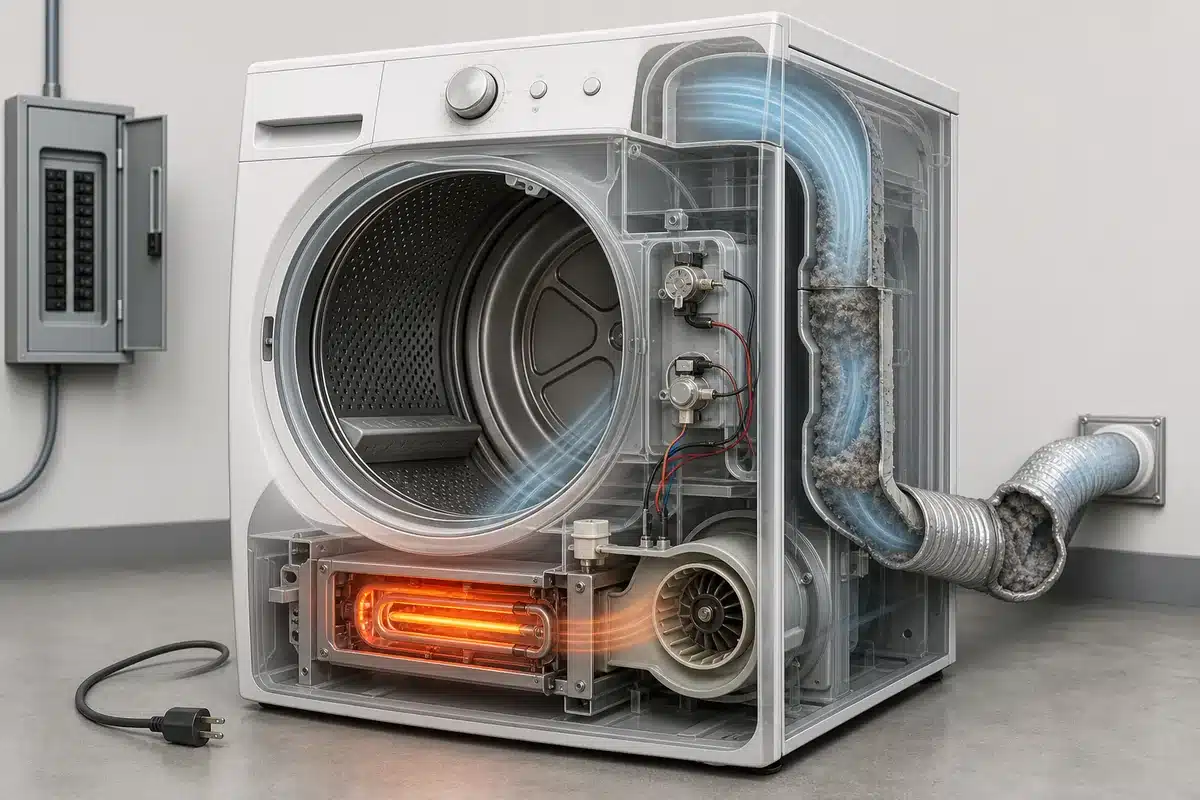
GE Dryer Not Heating – Causes & Fixes
1. Tripped Circuit Breaker (Start Here)
Electric dryers run on a 240-volt double-pole breaker; if one leg trips, the drum spins but no heat is produced. This is the quickest fix and costs nothing to check.
- Locate your home’s main electrical panel.
- Find the double-pole breaker labeled “Dryer” (usually 30 amp).
- If it is in the middle or “tripped” position, switch it fully OFF, then firmly back ON.
- Run a timed dry cycle for 5 minutes and feel for heat at the lint screen opening.
- If the breaker trips again immediately, stop use and call an electrician—do not force it back on.
2. Blown Thermal Fuse – Most Common Cause of a GE Dryer Not Heating
The thermal fuse is a one-time safety device that burns open permanently if the dryer overheats; once blown, it cuts power to the heating circuit entirely. A clogged exhaust vent is the number-one reason it blows, so always clear the vent when replacing the fuse.
- Unplug the dryer from the wall outlet.
- Remove the back panel (typically 6–8 Phillips or 1/4-in. hex screws).
- Locate the thermal fuse on the exhaust duct or burner housing—it is a small oblong component with two wires.
- Disconnect the wires and set your multimeter to continuity or Ohms.
- Touch the probes to each terminal: a good fuse shows continuity (beep or near-zero Ohms); no continuity means it is blown.
- Replace the fuse and fully clear the exhaust duct from dryer to outside before running again.
3. Faulty Heating Element (Electric Dryers)
The heating element is a coiled resistance wire that produces heat; a break anywhere in the coil stops all heat production. Visible breaks or a failed multimeter test confirm the element needs replacement.
- Unplug the dryer and remove the back panel.
- Locate the heating element housing (a metal box with a coiled wire visible through slots).
- Disconnect the two wires leading to the element terminals.
- Set your multimeter to Ohms and touch the probes to both terminals. A working element reads roughly 8–16 Ohms; an open (infinite) reading means it is failed.
- Inspect the element visually for obvious breaks or burn marks.
- Remove the mounting screws, pull out the element assembly, and install the replacement in reverse order.
4. Failed High-Limit Thermostat
The high-limit thermostat sits on the heating element housing and shuts off heat if temperatures exceed a safe threshold; unlike the thermal fuse it can sometimes reset, but it also fails permanently. A bad high-limit thermostat reads open on a multimeter at room temperature.
- Unplug the dryer and access the back panel.
- Locate the high-limit thermostat on the heating element housing—it is a small disc-shaped component held by one or two screws.
- Remove the wire connectors and test for continuity with your multimeter. A good thermostat shows continuity at room temperature.
- If no continuity is found, remove the mounting screws and swap in the new thermostat.
- Reconnect wires, reinstall the panel, and test the dryer.
5. Defective Cycling Thermostat
The cycling thermostat regulates operating temperature by cycling the heating element on and off throughout the drying cycle; when it fails closed or open, heat output is incorrect or absent. It is inexpensive and worth replacing together with the thermal fuse if the fuse has blown.
- Unplug the dryer and remove the back panel.
- Find the cycling thermostat on the blower housing or exhaust duct—it looks similar to the high-limit thermostat but is located in a different position.
- Remove the wires and test for continuity. A healthy cycling thermostat shows continuity at room temperature.
- Replace if open, then reinstall the panel and run a test cycle.
6. Blocked or Kinked Exhaust Vent (Gas & Electric)
A restricted vent traps heat, triggers the thermal fuse, and reduces heating efficiency even before a fuse blows—it is the root cause behind many repeat failures. Cleaning the vent is free and should be part of annual dryer maintenance.
- Pull the dryer away from the wall and disconnect the flexible duct from the back of the dryer.
- Shine a flashlight into the duct and inspect for lint blockages.
- Use a long dryer vent brush kit to clean the entire duct run to the exterior cap.
- Go outside and confirm the exterior vent flap opens freely and is not blocked by debris or a bird nest.
- Replace any accordion-style plastic duct with rigid or semi-rigid metal duct, which is safer and resists crushing.
- Reconnect the duct, push the dryer back, and run a test cycle.
- For detailed vent-cleaning guidance, see GE Appliances’ official dryer care tips (PDF).
Frequently asked questions
Why does my GE dryer run but produce no heat?
When a GE dryer tumbles normally but produces no heat, the most likely culprits are a blown thermal fuse, a tripped circuit breaker leg, or a failed heating element. Start by resetting the breaker, then use a multimeter to test the thermal fuse and heating element before replacing any parts.
Can I bypass the thermal fuse to test it?
Temporarily jumping the thermal fuse with a short wire will confirm whether it is the cause—if heat returns, the fuse was blown. However, never run the dryer long-term with the fuse bypassed; it is a critical safety device. Replace the fuse and fix the underlying vent blockage immediately.
How long does a GE dryer heating element last?
A heating element typically lasts 8–12 years under normal use. Shortened life is usually caused by restricted airflow from a clogged vent, which makes the element run hotter than designed. Keeping the vent clean extends both element and thermal fuse life significantly.
Does a gas GE dryer have a heating element?
No. Gas dryers use a gas valve, igniter, and flame sensor instead of a heating element. If a gas GE dryer is not heating, check the igniter (glows orange but no flame suggests a failed gas valve coil), the flame sensor, and the thermal fuse—the same fuse and thermostat checks described above still apply.