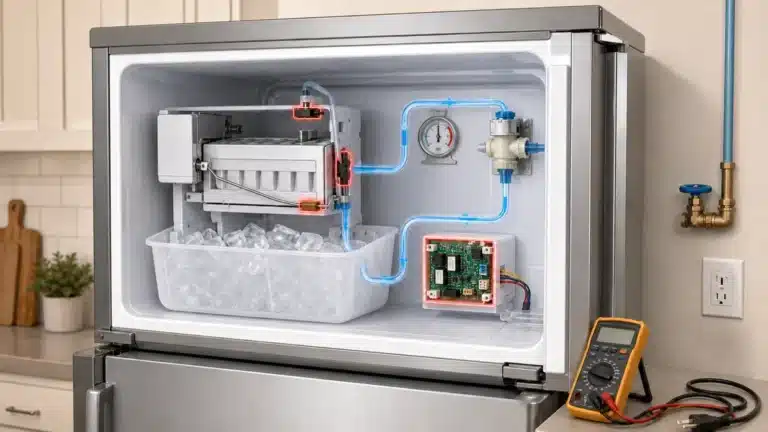
Samsung Refrigerator Error Codes: Causes & Fixes
1. Temperature Sensor Fault (codes 1E, 2E, SE)
A failed or disconnected temperature sensor sends out-of-range readings to the control board, triggering an error and causing the fridge to stop cooling correctly.
- Unplug the refrigerator and wait 60 seconds, then plug it back in. A soft reset clears temporary sensor glitches.
- Open the fridge and freezer compartments and look for any obvious disconnected wiring harness near the back wall.
- If the code returns, use a multimeter to test the suspect sensor for resistance. A reading far outside 5–10 kΩ at room temperature indicates a bad sensor.
- Replace the faulty sensor if readings are abnormal.
2. Defrost Heater or Defrost Sensor Failure (codes 5E, SE, 6E)
When the defrost heater or its associated thermal sensor fails, ice builds up on the evaporator coils, blocking airflow and tripping an error code on the display.
- Remove food from the freezer and unplug the unit. Allow 24–48 hours for ice to melt naturally, or use a hair dryer on low to speed up the process — keep it moving and away from plastic parts.
- After defrosting, plug the unit back in and check whether the code clears.
- Remove the freezer back panel and inspect the defrost heater for visible breaks or burn marks.
- Test the defrost heater with a multimeter. A reading of OL (open) means the heater has failed and needs replacement.
- Also test the defrost thermal sensor/thermostat with a multimeter; continuity should be present at room temperature.
3. Ice Maker Error (codes PC ER, 1C, ICE)
An ice maker error typically means the ice maker’s sensor, motor, or wiring has a fault, which Samsung’s control board flags to prevent overflow or mechanical damage.
- Press and hold the ice-maker’s test button (usually on the underside of the ice maker) for 3–5 seconds to run a self-test cycle and listen for the motor to turn.
- Check that the water supply line behind the fridge is not kinked and that the home water shut-off valve is fully open.
- Inspect the wiring harness connecting the ice maker to the main board for damaged or corroded pins.
- If the motor does not turn during the test cycle, the ice maker assembly likely needs replacement.
4. Fan Motor Failure (codes 22E, 23E, 24E, 40E)
Samsung refrigerators use evaporator and condenser fan motors to circulate cold air; if either motor seizes or its wiring fails, the control board logs a fan error and cooling drops sharply.
- Listen for unusual noise from the freezer or the rear of the fridge — a buzzing or absent hum points to the faulty fan.
- Unplug the unit and access the evaporator fan (behind the freezer back panel) or the condenser fan (behind the lower rear access panel).
- Spin the fan blade by hand; it should turn freely with no grinding. If it’s stiff or locked, the motor bearings have failed.
- Test the fan motor with a multimeter across its terminals. An OL reading confirms a failed motor winding.
- Replace the failed fan motor and reinstall the panel.
5. Water Leak / Drain Issue (codes 85E, 86E, CF)
A clogged or frozen defrost drain causes water to pool and can trigger water-related error codes as moisture reaches sensors or control components.
- Empty the crisper drawers and remove the drawer housing to expose the drain hole at the bottom of the refrigerator compartment.
- Pour a cup of hot (not boiling) water into the drain hole to melt any ice blockage.
- Use a turkey baster or a drain-cleaning tool to flush debris out of the drain tube that leads to the drip pan.
- Inspect the drain tube at the back of the unit to confirm water flows freely into the drip tray.
- If the code persists, check for a cracked drain pan beneath the unit and replace it if damaged.
6. Main Control Board Failure (code 88, or multiple simultaneous codes)
When the main control board fails or develops a short, it can display garbled characters, all eights (88 88), or several unrelated samsung refrigerator error codes at the same time.
- Perform a hard reset: unplug the refrigerator for 5 minutes, then plug it back in. Note whether the same code(s) reappear.
- Inspect the control board (located in the top rear compartment or behind a lower rear panel) for burnt traces, swollen capacitors, or corrosion.
- Check all wiring harness connectors on the board for secure seating; reseat any loose connectors.
- If damage is visible or the board does not power components properly after all other causes are ruled out, replace the main control board.
- Refer to the Samsung official refrigerator support page to verify the correct board for your specific model before ordering.
Frequently asked questions
How do I reset samsung refrigerator error codes?
The quickest reset is a power cycle: unplug the refrigerator from the wall outlet, wait 60 seconds, then plug it back in. This clears temporary faults stored in the control board’s memory. If the code reappears within a few hours, the underlying component fault must be diagnosed and repaired — a reset alone won’t fix a hardware failure.
Is it safe to keep using my Samsung fridge when an error code is displayed?
It depends on the code. Fan and sensor errors mean the fridge is likely not maintaining safe temperatures, so food spoilage is a real risk. You should transfer perishables to a cooler, address the fault promptly, and avoid using the appliance for food storage until the error is resolved.
What does the “88 88” or “8E” display mean?
A display showing all eights or “8E” usually indicates a communication error between the display board and the main control board, or a power surge that corrupted the board’s memory. Try a hard reset (5-minute unplug) first. If the display remains garbled, inspect the ribbon cable connecting the display to the control board, and test or replace the main control board if the cable is intact.
How much does it typically cost to repair a Samsung refrigerator error code fault?
DIY part costs range from roughly $15–$40 for a sensor or thermostat, $50–$120 for a fan motor or ice maker assembly, and $100–$250 for a main control board. Professional labor adds $80–$150 per hour on average. Comparing the repair total to the age and replacement cost of the refrigerator helps determine whether repair or replacement is the better investment.