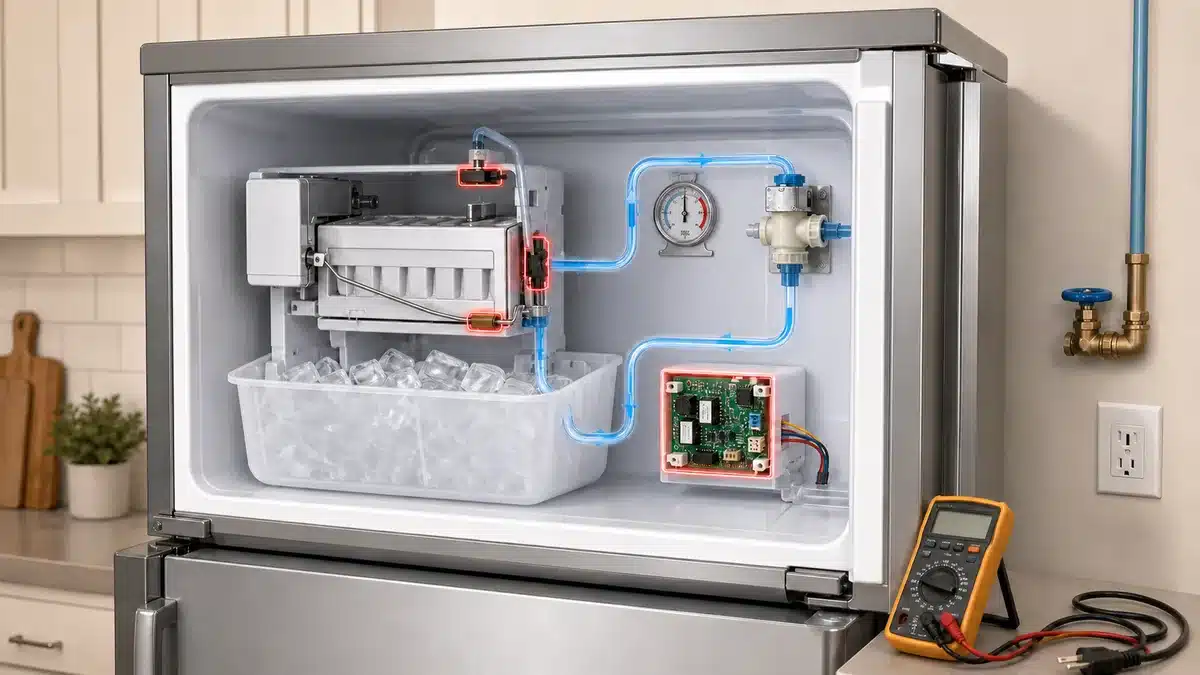
Refrigerator Ice Maker Not Working – Fix It Fast
1. Ice maker is turned off or the feeler arm is raised
Many ice makers have a simple on/off switch or a wire feeler arm that halts production when lifted. This is the most overlooked cause and costs nothing to fix.
- Open the freezer and locate the ice maker unit, usually mounted on the left or right wall.
- Check for an on/off switch or toggle; make sure it is set to ON.
- If your model uses a wire feeler arm, ensure it is in the lowered (down) position.
- Wait 24 hours for a new cycle to complete before testing further.
2. Freezer temperature is too warm
The ice maker requires the freezer to be between 0 °F and 5 °F (−18 °C to −15 °C) to freeze water properly. A warmer compartment stops ice production entirely.
- Place a thermometer in the freezer for 30 minutes and note the reading.
- If the temperature is above 10 °F (−12 °C), adjust the freezer control to a colder setting.
- Check that the freezer door gasket seals tightly — run a dollar bill around the edge; resistance when pulling it out indicates a good seal.
- Inspect the condenser coils (usually at the back or underneath) for heavy dust buildup and vacuum them clean.
- Allow 24 hours for the freezer to stabilise before re-testing the ice maker.
3. Frozen or kinked water supply line
A frozen fill tube or kinked supply line prevents water from reaching the ice maker mold, so no ice can form even when everything else is working.
- Pull the refrigerator away from the wall and inspect the plastic supply line for kinks or damage.
- Use a hair dryer on low heat to gently thaw any ice visible inside the fill tube at the back of the freezer — keep the dryer moving and avoid prolonged heat in one spot.
- Straighten any kinks and ensure the line is not pinched by the refrigerator body.
- Turn the water supply valve (behind the fridge or under the sink) fully open.
4. Clogged or faulty water inlet valve
The water inlet valve is a solenoid-operated valve that opens to let water flow into the ice maker. Mineral deposits or a failed solenoid will block water flow entirely.
- Shut off the water supply to the refrigerator.
- Locate the water inlet valve at the back of the refrigerator near the water line connection.
- Inspect the inlet screen for sediment; carefully remove and rinse the screen if accessible.
- Use a multimeter to test the solenoid coil for continuity — no continuity indicates a failed valve that needs replacement.
- Replace the valve if it fails the continuity test or shows visible cracks.
5. Ice maker not working due to a failed ice maker module or thermostat
The ice maker module controls the harvest cycle — including the heater, motor, and thermostat. A faulty module or thermostat means the cycle never triggers, so no ice is ejected or refilled.
- Remove the ice maker assembly from the freezer wall (typically two or three screws).
- Inspect the wiring harness connector for corrosion or loose pins; reseat the connector firmly.
- Use a multimeter to test the ice maker thermostat for continuity when cold — a lack of continuity at freezer temperature indicates a failed thermostat.
- If the thermostat tests good but the module still does not cycle, the module itself is likely faulty and should be replaced as a unit.
6. Faulty ice level control board or main control board
Newer refrigerators use an electronic ice level control board or a main control board to manage ice production. A failed board can shut down the ice maker even when all mechanical components are fine.
- Unplug the refrigerator for 5 minutes to perform a hard reset — this clears temporary electronic faults.
- Plug the refrigerator back in and wait up to 24 hours to see if ice production resumes.
- Consult your refrigerator’s technical service sheet (usually taped inside a cabinet panel) for any diagnostic mode or error codes.
- Visually inspect the control board for burnt components, blown fuses, or signs of arcing — any visible damage confirms a failed board.
- If the board appears damaged, replace it; control board replacement is best left to a qualified technician due to high-voltage components.
Frequently asked questions
How long does it take for an ice maker to start producing ice after being repaired?
After a repair or reset, most ice makers take 24 hours to reach the correct freezer temperature and complete their first full harvest cycle. Some models may produce a small amount of ice within 6–12 hours. Discard the first one or two batches if any parts or water lines were replaced, as residue from new components can affect taste.
Why is my refrigerator making ice slowly rather than stopping completely?
Slow ice production is usually caused by a freezer temperature that is slightly too warm (above 5 °F / −15 °C), low household water pressure (you need at least 20 psi), or a partially clogged water inlet valve screen. Check and correct the temperature first, then verify your water pressure with a simple gauge, and clean the inlet valve screen if pressure is adequate.
Is it safe to manually force a test cycle on the ice maker?
Yes, on most ice makers you can initiate a manual test cycle by pressing and holding the test button (a small recessed button on the module) for 3–5 seconds until you hear a chime or the motor starts turning. This is safe and useful for diagnosing whether the module itself is operational. Do not run repeated test cycles back-to-back, as the mold needs time to freeze between cycles.
Where can I find the official troubleshooting guide for my refrigerator’s ice maker?
The best starting point is your refrigerator manufacturer’s official support website, where you can enter your model number for the exact service manual and wiring diagrams. You can also find general refrigerator ice maker guidance at the U.S. Department of Energy’s appliance resource pages, which cover energy and usage tips that affect appliance performance.