Oven Not Heating Up? Causes & Fixes (Step-by-Step)
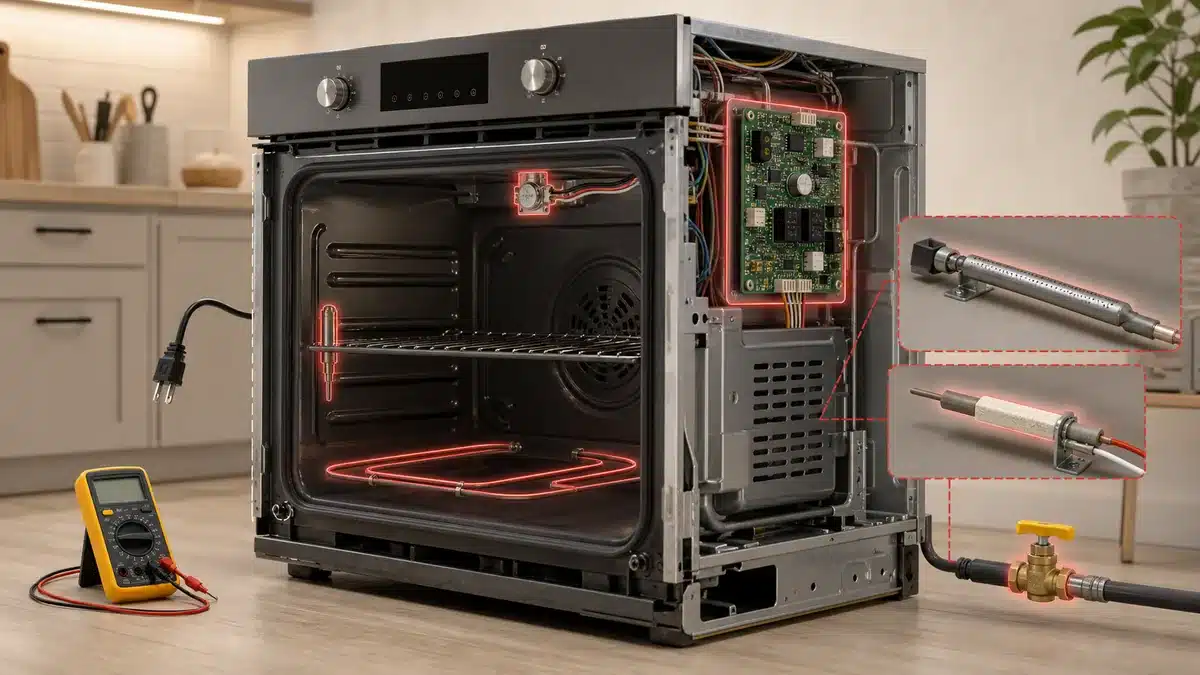
1. Burned-Out Bake Element (Electric Ovens)
The bake element sits at the bottom of the oven cavity and provides the primary heat source. If it has burned through or blistered, the oven will not reach temperature.
- Unplug the oven or switch off its circuit breaker.
- Remove oven racks and locate the bake element at the bottom of the cavity.
- Visually inspect the element for visible breaks, blistering, or burn marks.
- Remove the two screws securing the element and pull it forward gently.
- Disconnect the wires and use a multimeter set to Rx1 to test for continuity. A reading of infinity means the element has failed.
- Replace the element if defective and restore power to test.
2. Weak or Faulty Igniter (Gas Ovens)
The igniter is the most common reason a gas oven stops heating—it must draw enough current to open the gas valve, and a weak igniter fails to do so even if it still glows faintly.
- Turn off the gas supply and unplug the oven.
- Remove the oven floor panel to access the igniter near the burner tube.
- Turn the oven to Bake and observe the igniter. It should glow bright orange within 90 seconds and the burner should light.
- If the igniter glows but the burner does not light within 2 minutes, the igniter is too weak to open the valve.
- Disconnect the igniter wires (use a multimeter to check resistance—most igniters should read between 0 and 1,100 ohms).
- Replace the igniter and retest.
3. Blown Thermal Fuse
The thermal fuse is a one-time safety device that blows if the oven overheats, cutting power to the heating circuit entirely. Once blown, it must be replaced—it cannot be reset.
- Disconnect power to the oven.
- Access the thermal fuse, typically located behind the rear panel or near the control board—consult your owner’s manual for its exact location.
- Remove the fuse and test it with a multimeter on the continuity setting. No continuity confirms it is blown.
- Note the temperature rating printed on the fuse before purchasing a replacement.
- Install the new fuse, reassemble the panel, and restore power to verify the oven heats correctly.
- Investigate why the oven overheated (e.g., blocked vents, faulty thermostat) to prevent a repeat failure.
4. Defective Oven Temperature Sensor (RTD Probe)
The temperature sensor monitors the internal oven temperature and signals the control board to cycle heat on and off. A faulty sensor causes the oven to heat erratically or not at all.
- Unplug the oven and locate the temperature sensor probe, usually mounted on the rear wall inside the oven cavity.
- Pull the sensor forward and disconnect its wires.
- Test resistance with a multimeter. At room temperature (~70 °F / 21 °C) most sensors read approximately 1,080–1,100 ohms. Consult your manual for your specific value.
- If the reading is far outside range or shows no continuity, replace the sensor.
- Re-mount the new sensor, reconnect wires, restore power, and run an oven calibration cycle if your model supports it.
5. Failed Oven Control Board
The electronic control board manages every heating function; if it fails, it may send no power to the heating elements or igniter at all. This is typically diagnosed only after ruling out all other components.
- Disconnect power to the oven.
- Access the control board, usually located behind the rear control panel.
- Inspect the board visually for burned spots, damaged relays, or cracked solder joints.
- If you have confirmed all other parts (element, igniter, fuse, sensor) are in working order, the control board is the likely culprit.
- Note the part number on the board’s label—use this as a reference for a generic equivalent if an OEM board is unavailable.
- Replace the board, restore power, and test all oven functions.
6. Tripped Circuit Breaker or No Gas Supply
Before replacing any parts, always rule out a simple power or gas supply issue—these require no tools and take under five minutes to check.
- Electric ovens: Go to your home’s electrical panel and look for a tripped breaker labeled “Range” or “Oven.” Reset it by switching it fully OFF, then ON.
- Plug a small appliance into the outlet behind the oven (if accessible) to confirm the outlet is live.
- Check that the oven’s power cord is firmly seated in the outlet and undamaged.
- Gas ovens: Confirm the gas shutoff valve behind the oven is fully open (handle parallel to the pipe).
- Test another gas appliance (e.g., a stovetop burner) to verify gas is flowing to your home.
- If your gas supply is interrupted, contact your gas utility provider immediately—do not attempt to repair gas lines yourself.
For general oven safety guidelines and wiring diagrams, see the ENERGY STAR Appliances resource page for additional reference material on oven specifications and efficiency standards.
Frequently asked questions
How long should an oven take to preheat?
Most ovens reach 350 °F (175 °C) in 10–15 minutes. If your oven is taking 20 minutes or longer, the bake element or igniter is likely weakening and may be the reason your oven is not heating up to the correct temperature efficiently.
Can I still use the broiler if the bake element is broken?
Yes—on electric ovens the broil element is a separate component at the top of the cavity. If only the bake element has failed, the broiler may still function normally. However, baking results will be unreliable, so replace the bake element promptly.
Is it safe to replace an oven igniter myself?
Yes, for a confident DIYer. Always turn off the gas supply and unplug the oven before starting. The igniter connector is low-voltage and the swap typically requires only a screwdriver. If you smell gas at any point during the repair, stop immediately, ventilate the area, and call a professional.
How much does it cost to repair an oven that is not heating?
DIY parts typically cost $20–$120 depending on the component—igniters and elements are on the lower end, control boards on the higher end. Professional repair labor adds $100–$250 on average. If the repair cost approaches 50% of the oven’s replacement value, buying a new appliance is usually the better financial choice.