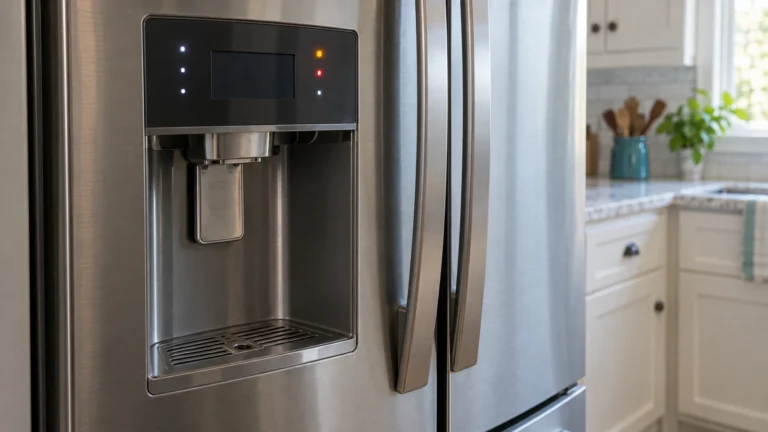
Refrigerator Not Cooling? Causes, Fixes and When to Call
This guide works for every brand. Where Whirlpool, GE, Samsung, LG and Frigidaire differ (mostly demo mode and recommended settings), each step says so, and the related links at the bottom go to brand-specific guides.
Fridge not cooling: match what you see
| What you notice | Most likely cause | Next step |
|---|---|---|
| Lights and display on, nothing cold (new or moved fridge) | Demo or cooling-off mode | Demo mode |
| Freezer cold, fridge warm | Blocked vents, frost on the coil, or a failed freezer fan | Vents, then frost and fans |
| Both fridge and freezer warm, fridge running | Dirty or boxed-in condenser coils, condenser fan, compressor | Coils |
| Thick frost on the freezer’s back wall | Defrost system fault | Technician |
| Condensation around the door, warm spots | Door seal not sealing | Dollar bill test |
| Clicking every few minutes, never cools | Start relay or compressor | Technician |
| Warmer since you changed the setting | Hasn’t settled yet | Wait 24 hours |
How cold air reaches the fridge
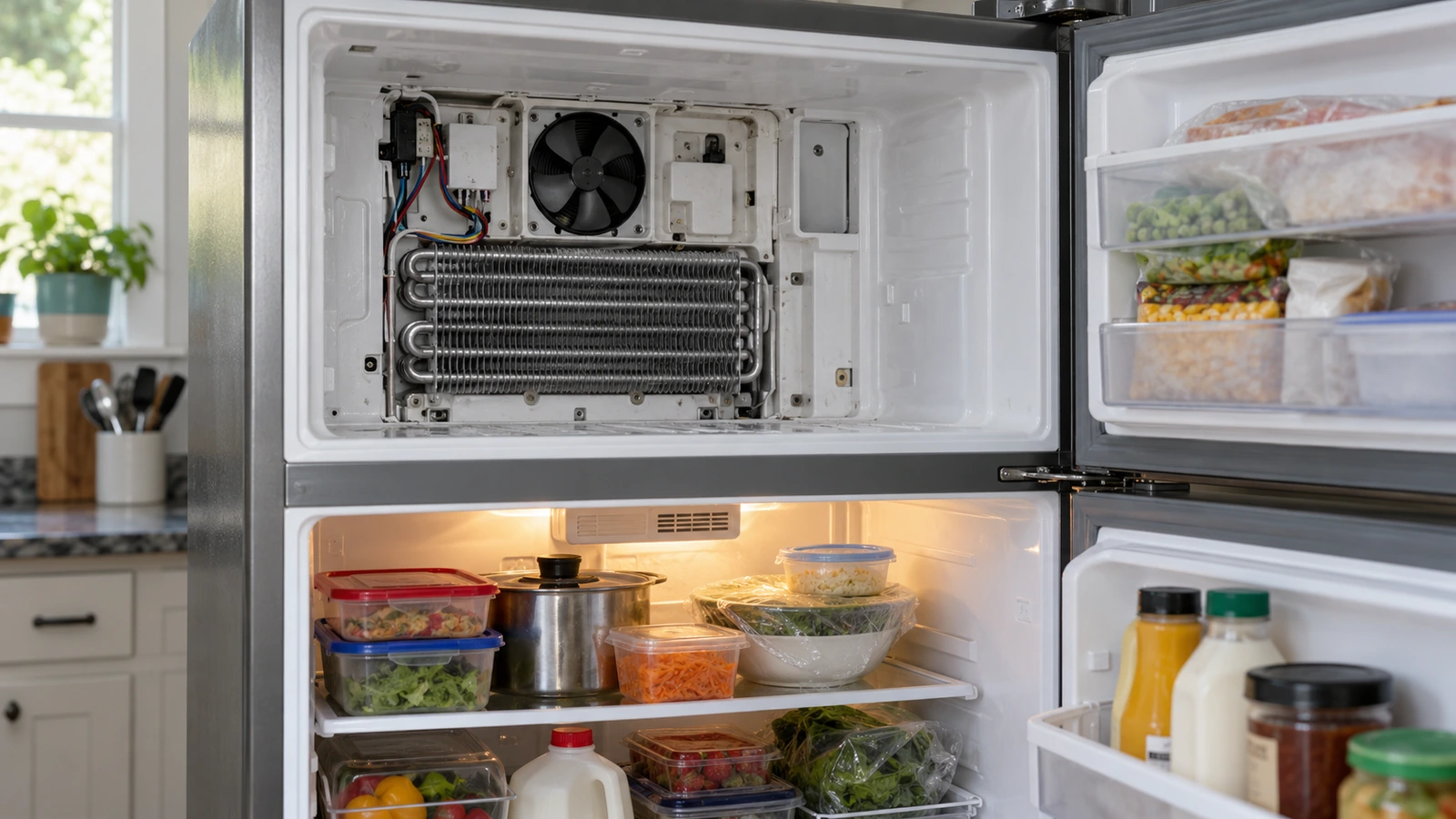
In most frost-free refrigerators the cold is made only in the freezer. Whirlpool explains that “cold air is generated in the freezer and pushed into the fresh food section through vents.” That’s why a fridge can be warm while the freezer is still cold.
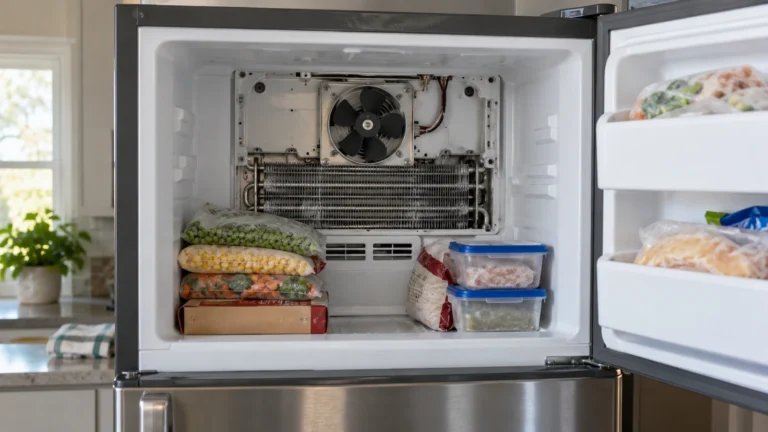
- Evaporator coil behind the freezer’s back panel: thick frost here means a defrost fault (technician).
- Freezer fan: if it’s silent with the doors shut, no cold air moves (technician).
- Vents between freezer and fridge: keep food away from them.
- Condenser coils at the bottom or back: unplug, then vacuum.
- Compressor and condenser fan: technician only.
- Door seals: do the dollar bill test.
1. Check the settings, then wait 24 hours
Whirlpool recommends keeping a fridge “between 33°F and 40°F, with the ideal temperature right around 37°F.” Frigidaire’s factory settings are “37°F and the freezer is 0°F.” The FDA notes that “few refrigerator controls show actual temperatures,” so put an appliance thermometer in a glass of water on the middle shelf. After any change, wait: Frigidaire says “The unit will need 24 hours for the temperature to stabilize,” and Samsung allows “up to 28 hours” with the doors closed.
2. Make sure it isn’t in demo or cooling-off mode
Store display fridges are often delivered with demo mode on: the lights and display work, but the cooling is off. Whirlpool: “The refrigerator and freezer will not cool, even after changing the temperature settings.”
- Samsung calls it Cooling Off mode; the display shows “OF OF, O FF, OFF OFF, or scrolling temperature bars.” The button combination depends on the panel; on many it’s holding the top two left buttons for about 8 seconds until it chimes.
- LG shows “O F F”. LG says the feature “disables all cooling in the refrigerator and freezer sections.” On 2018 and older models, hold REFRIGERATOR and ICE PLUS together for five seconds.
- GE uses different buttons on different models, and on some, “Unplugging the refrigerator will not deactivate demo mode.” Check your manual.
3. Clear the vents
Frigidaire: “Blocked vents will prevent air flow and the unit will not be able to cool properly.” Samsung says to keep food “2 inches clear of the interior vents.” Check the vent in the freezer (often behind a pizza box or bag of frozen vegetables) and the outlets in the fridge, and don’t pack shelves against the back wall.
4. Test the door seals
Samsung’s dollar bill test: “Place the dollar bill halfway in the door, close the door on it, and then pull the bill out.” You should feel resistance. Try several spots around each door. If it slides out, clean the gasket with warm soapy water and check nothing (a drawer, a tall bottle) is holding the door open. A torn or flattened gasket needs replacing.
⚠️ Caution: unplug before you open anything
Unplug the refrigerator before you remove the bottom grille, clean the coils or take off any panel. Don’t chip frost with a knife or screwdriver, and don’t use a heat gun; you can puncture a refrigerant line or crack plastic. Compressor, refrigerant and sealed-system work needs an EPA-certified technician.
5. Give the coils room and clean them
The condenser coils get rid of the heat taken out of the fridge. If they’re coated in dust or the fridge is boxed in, it can’t cool well.
- Clearance: Whirlpool recommends “½ inch clearances on the sides and 1 inch in the back.” Samsung asks for “2 inches clearance at the back, top, and sides.”
- Room temperature: Frigidaire: “We do not recommend installing the unit where the temperature will drop below 55°F.” Samsung says a room “above 110°F, or below 50°F” stops it cooling properly. Garage fridges often fail this test in winter.
- Cleaning: Whirlpool says “there is typically no need for routine condenser cleaning in a normal home operating environment,” but recommends cleaning “every 2 to 3 months” in dusty homes or homes with pets. Unplug first, then vacuum behind the bottom grille or at the back.
6. Reset the controls
Samsung: “unplug it or turn it off at the circuit breaker for 2 minutes, and then turn it back on.” Then leave it closed and give it 24 hours. A reset clears a confused control; it doesn’t fix frost, a failed fan or a compressor.
7. Frost on the back wall, or a silent fan
A frost-free freezer shouldn’t build up thick frost. If the back wall is white with ice and the fridge is warm, the defrost system (heater, its thermostat or the control) has likely failed, and the frost is blocking the air. LG’s temporary fix is a manual defrost: unplug the fridge, empty it, leave the doors open for at least 8 hours with towels down, then plug it back in and allow 24 to 48 hours. If the frost comes back within days, it’s a repair. With the freezer door shut (press the door switch), you should hear the freezer fan; a silent fan is a technician job too. Whirlpool says fans, the compressor and the start relay are best “left to a professional.”
Keep food safe while you fix it
The FDA says to keep the fridge at 40°F or below and the freezer at 0°F. FoodSafety.gov says a closed refrigerator keeps food safe for about 4 hours without cooling; a full freezer holds for about 48 hours and a half-full one about 24. Keep the doors shut, and move milk, meat and leftovers to a cooler with ice if the fridge has been warm for longer.
What fridge cooling repairs usually cost
| Repair | Typical cost | Source |
|---|---|---|
| Refrigerator repair, typical | $350 to $500 (average $400) | Fixr (Aug 2025) |
| Service call or diagnostic | $60 to $120 | HomeAdvisor (June 2026), Fixr |
| Condenser coil cleaning | $60 to $100 | Fixr (Aug 2025) |
| Evaporator fan | $120 to $200 | Fixr (Aug 2025) |
| Door seal | $60 to $100 | Fixr (Aug 2025) |
| Refrigerant leak repair | $200 to $300 | Fixr (Aug 2025) |
| Compressor | $500 to $1,000 | Fixr (Aug 2025) |
When to call a technician
Call if the settings, demo mode, vents, seals and coils check out and it’s still warm after 24 hours; if the freezer’s back wall frosts over; if the freezer fan is silent; or if you hear clicking without the compressor running. Frigidaire and Samsung both say that for a fridge installed within the past 30 days, contact the installer first. Have the model and serial number (on a label inside the fresh-food section) ready. Print the checklist.
Frequently asked questions
How do you fix a refrigerator that is not cooling?
Check the setting, demo mode, vents, door seals and coils, then unplug it for 2 minutes and give it 24 hours. If it’s still warm, or the freezer wall is frosted over, call a technician.
Why is my freezer cold but my fridge warm?
Cold air comes from the freezer through vents. Blocked vents, a frosted evaporator coil or a failed freezer fan stop it reaching the fridge.
Does unplugging a fridge reset it?
Yes, it resets the controls. Samsung says to unplug it (or switch off the breaker) for 2 minutes. It won’t fix a failed part.
How do I reset a refrigerator compressor?
There’s no separate compressor reset for homeowners. Power-cycle the fridge for 2 minutes. If the compressor still clicks on and off without running, the start relay or compressor needs a technician.
How long does a fridge take to get cold?
Up to 24 hours after installation or a setting change; Samsung allows up to 28 hours.
What temperature should my refrigerator be?
40°F or below (FDA). Whirlpool suggests about 37°F, and the freezer at 0°F.
Sources: Whirlpool: refrigerator not cooling · Frigidaire: not cooling · Samsung: cooling issues · Samsung: cooling off mode · LG: disable demo mode · GE: demo modes · FDA: refrigerator thermometers · FoodSafety.gov: power outages · Whirlpool: freezer troubleshooting · Fixr: refrigerator repair cost · HomeAdvisor: refrigerator repair cost.
Updated October 23, 2026. Written and edited by Jordan Hale. Steps checked against Whirlpool, Frigidaire, Samsung, LG and GE support pages and FDA guidance; no hands-on test is claimed. Buttons vary by model, so follow your owner’s manual.