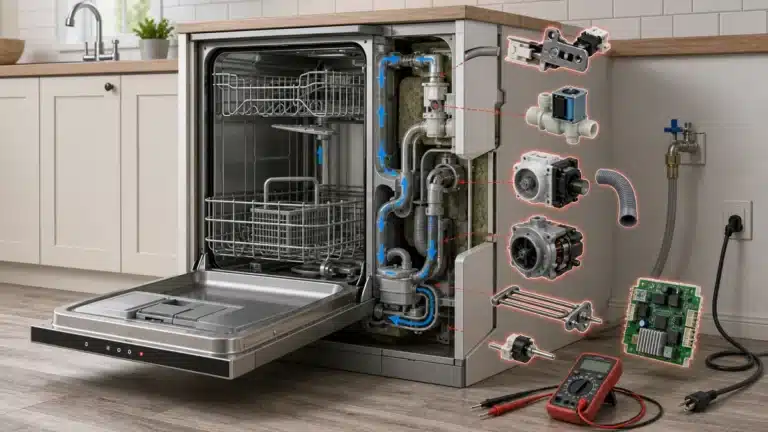
Kenmore Dishwasher Not Draining – Fix It Fast
1. Clogged or Dirty Filter (Most Common First Step)
Food debris and grease accumulate in the filter basket over time, restricting water flow and preventing the dishwasher from draining completely. This is the easiest fix and should always be checked first.
- Remove the lower dish rack to access the bottom of the tub.
- Twist and lift out the cylindrical filter, then remove the flat mesh screen beneath it.
- Rinse both filter components under warm running water, scrubbing gently with a soft brush and dish soap.
- Inspect for any cracks or damage while cleaning.
- Reinstall the filter and screen, then run a short cycle to test drainage.
2. Blocked or Kinked Drain Hose
The drain hose carries water from the pump to your sink drain or garbage disposal; a kink, clog, or improper loop can stop drainage entirely. Check this before suspecting an electrical component.
- Pull the dishwasher forward slightly or open the cabinet beneath your sink to access the drain hose.
- Visually inspect the hose for kinks, sharp bends, or obvious blockages.
- Disconnect the hose at both ends (have a towel ready) and blow through it or flush with water to confirm it is clear.
- Ensure the hose has a high loop — it should rise to the underside of the countertop before descending — or is connected to an air gap fitting.
- Reconnect securely and run a rinse cycle to verify draining.
3. Garbage Disposal Knockout Plug Not Removed
If your dishwasher drain hose connects to a newly installed garbage disposal, a plastic knockout plug inside the disposal inlet may still be in place, completely blocking drainage. This is a quick and free fix.
- Locate the dishwasher inlet port on the side of the garbage disposal (usually a small stub).
- Disconnect the drain hose from the disposal inlet.
- Insert a screwdriver into the inlet port and tap firmly with a hammer to knock out the plastic plug.
- Retrieve the plug from inside the disposal before running it.
- Reconnect the drain hose, clamp it securely, and test drainage.
4. Faulty or Obstructed Drain Pump
The drain pump uses an impeller to force water out of the tub; a broken impeller blade, seized motor, or piece of broken glass can stop it from working. You will often hear a humming sound or no sound at all during the drain cycle if the pump has failed.
- Disconnect power to the dishwasher at the circuit breaker before proceeding.
- Remove the lower spray arm and filter assembly to expose the pump cover at the bottom of the tub.
- Remove the pump cover (usually secured by a quarter-turn or two screws) and check the impeller area for debris, glass, or broken plastic — remove any obstructions carefully.
- Spin the impeller by hand; it should turn freely. If it is seized or broken, the pump needs replacement.
- For a confirmed pump failure, see the part link below and consult your model’s wiring diagram available on the Kenmore official support page.
- Reinstall all components, restore power, and run a test cycle.
5. Defective Check Valve or Drain Valve
The check valve (also called a flapper valve) prevents drained water from flowing back into the tub; if it sticks closed or is worn, water cannot exit. A separate solenoid-operated drain valve, found on some Kenmore models, can also fail to open during the drain cycle.
- Disconnect power before beginning.
- Access the check valve at the outlet side of the drain pump — it is typically a small rubber flap or ball inside a plastic housing.
- Remove the valve and inspect it for tears, warping, or debris preventing movement. Clean or replace as needed.
- If your model uses a solenoid drain valve, test it for continuity with a multimeter; a reading of infinity (open circuit) means it has failed and must be replaced.
6. Control Board or Timer Failure (Least Common)
If all mechanical components check out, the electronic control board or mechanical timer may not be sending the signal to initiate the drain cycle. This is the least common cause of a kenmore dishwasher not draining and typically requires professional diagnosis.
- Check for any error codes on the display and note them — refer to your model’s user guide for code definitions.
- Perform a hard reset: disconnect power at the breaker for 5 minutes, restore power, and run a new cycle.
- If the dishwasher drains manually when you enter a Service/Diagnostic mode but not during a normal cycle, the control board is likely at fault.
- Inspect the control board for burnt spots or damaged connectors; replace if visually damaged.
Frequently asked questions
How much water sitting in the bottom of my Kenmore dishwasher is normal?
A small amount of water — roughly 1 to 2 cups — pooled at the very bottom of the tub after a cycle is normal and intentional; it keeps the door gasket from drying out. Anything deeper than about an inch, or water covering the filter, indicates a genuine draining problem that should be investigated.
Can I run my Kenmore dishwasher if it is not draining properly?
It is best not to run additional cycles until you resolve the issue. Standing water can promote bacterial growth and odors, and forcing the dishwasher to run repeatedly without draining can overheat the pump motor, turning a simple fix into a costly repair.
How do I manually drain standing water from my Kenmore dishwasher before I start repairs?
Lay old towels around the base of the dishwasher, then use a large cup or ladle to scoop out as much water as possible. Remove the remaining water with a wet-dry vacuum or by soaking it up with sponges. This gives you a dry workspace and prevents spills when you remove the filter or pump cover.
How often should I clean the filter to prevent draining problems?
Kenmore recommends cleaning the filter at least once a month under normal use. If you frequently wash heavily soiled dishes or run the dishwasher daily, inspect the filter every two weeks. Regular cleaning is the single most effective step for preventing a kenmore dishwasher not draining in the future.