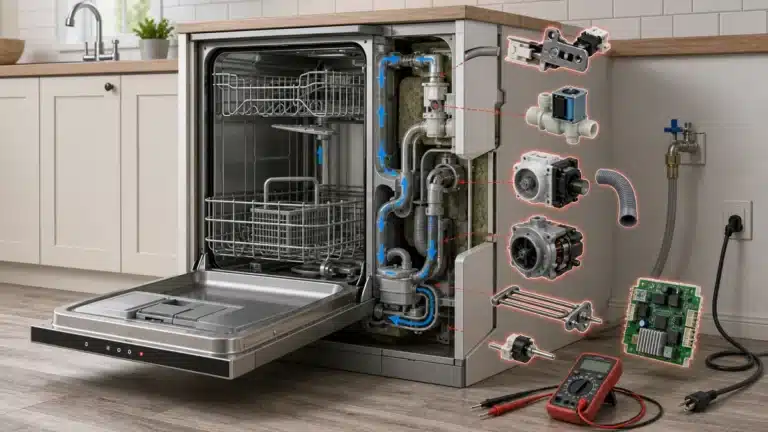
KitchenAid Dishwasher Not Draining – Fix It Fast

Quick answer A kitchenaid dishwasher not draining is most often caused by a clogged filter, blocked drain hose, or a failed drain pump. Clearing debris and checking the hose resolves the problem in most cases.

1. Clogged Filter Assembly (Most Common Cause)

KitchenAid dishwashers use a multi-part filter at the bottom of the tub that traps food particles. When it becomes heavily clogged, water cannot flow to the drain and pools at the bottom of the machine.

  1. Remove the bottom rack and locate the cylindrical filter in the center of the tub floor.
  2. Turn the upper filter counterclockwise and lift it out, then lift out the flat mesh filter beneath it.
  3. Rinse both filter pieces under warm running water, using a soft brush to remove stubborn grease and debris.
  4. Inspect the filter housing in the tub for any remaining debris and wipe it clean with a damp cloth.
  5. Reinstall the flat filter first, then twist the cylindrical filter clockwise until it locks into place.
  6. Run a short rinse cycle to confirm water is now draining properly.
Replacement filter assembly — If the mesh is torn or the housing is cracked, the filter will not catch debris correctly and should be replaced.
Check price

2. Blocked or Kinked Drain Hose

The drain hose carries water from the pump to your sink drain or garbage disposal. A kink, clog, or improper installation height can create a siphon effect or blockage that prevents the dishwasher from draining fully.

  1. Pull the dishwasher forward slightly (after turning off power at the circuit breaker) to access the drain hose at the back.
  2. Visually inspect the entire length of the hose for kinks or sharp bends and straighten any you find.
  3. Disconnect the hose at the sink drain or garbage disposal end and check for clogs; clear any blockage with a long bottle brush or by flushing with water.
  4. Confirm the drain hose forms a high loop — rising to at least the underside of the countertop — before descending to the drain connection. This prevents backflow.
  5. If the hose connects to a garbage disposal, make sure the knockout plug inside the disposal’s dishwasher inlet has been removed.
  6. Reconnect everything, restore power, and run a drain cycle.
Replacement drain hose — Replace the hose if it is cracked, brittle, or cannot hold its shape after straightening.
Check price

3. Clogged or Faulty Drain Pump

The drain pump forces water out of the sump and through the drain hose. If the pump impeller is jammed with debris, or the pump motor has failed, you will hear a humming noise (or nothing at all) while water sits in the tub — a clear sign of a kitchenaid dishwasher not draining.

  1. Turn off power to the dishwasher at the circuit breaker before proceeding.
  2. Remove the bottom rack, filter assembly, and any standing water using a towel or wet/dry vacuum.
  3. Locate the pump cover at the bottom of the tub and remove it according to your model’s layout (usually a quarter-turn or a few screws).
  4. Check the pump impeller area for glass shards, broken pieces of plastic, or food debris; remove anything you find using needle-nose pliers.
  5. Spin the impeller gently with a finger — it should rotate freely. A seized impeller indicates a failed pump motor.
  6. If the impeller spins freely but the dishwasher still won’t drain after clearing debris, use a multimeter to test the pump motor for continuity. No continuity means the pump needs replacement.
Replacement drain pump — A pump that is seized, burned out, or fails the continuity test must be replaced to restore proper draining.
Check price

4. Defective Drain Solenoid or Drain Valve

On some older KitchenAid dishwasher models, a solenoid-operated drain valve opens to allow water to exit. If the solenoid coil burns out or the valve flapper becomes stuck closed, water cannot leave the tub.

  1. Disconnect power and locate the drain valve, typically mounted near the pump at the bottom of the machine.
  2. With the valve in place, actuate the solenoid arm by hand — it should move freely without sticking.
  3. Use a multimeter to test the solenoid coil for continuity. A reading of infinite resistance (open circuit) confirms the coil has failed.
  4. Inspect the rubber flapper inside the valve; if it is warped, torn, or stuck, it will prevent water from passing through.
  5. Replace the drain solenoid/valve assembly if either the coil or flapper is defective.
Replacement drain valve and solenoid — Replace the complete assembly when the solenoid coil has failed or the flapper valve is damaged.
Check price

5. Garbage Disposal or Sink Drain Blockage

Because the dishwasher drain typically ties into the household plumbing at the garbage disposal or sink drain, a clog in that section of your plumbing will back water up into the dishwasher.

  1. Run your garbage disposal for 30 seconds to clear any food build-up from the inlet port.
  2. Fill your kitchen sink and confirm it drains quickly. Slow sink drainage points to a plumbing blockage, not a dishwasher fault.
  3. If the sink drains slowly, use a plunger or drain snake to clear the blockage in the sink drain or P-trap.
  4. Once the sink drains freely, run a dishwasher drain cycle to verify the problem is resolved.

6. Faulty Control Board or Door Latch Switch

If the dishwasher’s control board is not sending the correct signal to the drain pump, or a malfunctioning door latch switch is telling the board the door is open mid-cycle, the drain cycle may simply never initiate.

  1. Check for any error codes on the dishwasher’s display and look them up in your owner’s manual or on the official KitchenAid support page.
  2. Press and hold the “Cancel/Drain” button for three seconds to force a drain cycle; if the pump runs, the issue may be cycle-related rather than mechanical.
  3. Inspect the door latch for physical damage and confirm the door clicks firmly shut before starting a cycle.
  4. Test the door latch switch for continuity with a multimeter; replace it if it reads open when the door is fully closed.
  5. If error codes point to the main control board and all other components test normal, have the board professionally diagnosed before replacing it — boards are expensive.
Replacement door latch switch — A latch switch that fails the continuity test should be replaced before assuming the control board is at fault.
Check price
Still stuck or prefer a pro? Find a local technician

Frequently asked questions

Why is there standing water in the bottom of my KitchenAid dishwasher?

A small amount of standing water (less than an inch) at the very bottom of the sump is normal and keeps the pump seal from drying out. However, if water covers the entire floor of the tub after a cycle, you have a draining issue — most likely a clogged filter, blocked drain hose, or failed drain pump.

How do I manually force my KitchenAid dishwasher to drain?

Press and hold the “Cancel/Drain” button for three to five seconds. The dishwasher should beep and begin a two-minute drain cycle. If the pump runs but water remains, the drain path (hose or filter) is likely blocked. If nothing happens, the pump or control board may be at fault.

How often should I clean my KitchenAid dishwasher filter?

KitchenAid recommends cleaning the filter approximately once a month for average household use. If you run heavy loads or rarely pre-rinse dishes, inspect and clean the filter every two weeks to prevent build-up that leads to draining problems.

Can a kitchenaid dishwasher not draining problem damage the appliance?

Yes. Prolonged standing water can cause the pump seals to degrade, promote mold and mildew growth inside the tub and door gasket, and eventually corrode internal components. Address a draining issue as soon as you notice it to avoid more costly repairs.

Related problems

See all Dishwasher guides →

Similar Posts

Leave a Reply

Your email address will not be published. Required fields are marked *