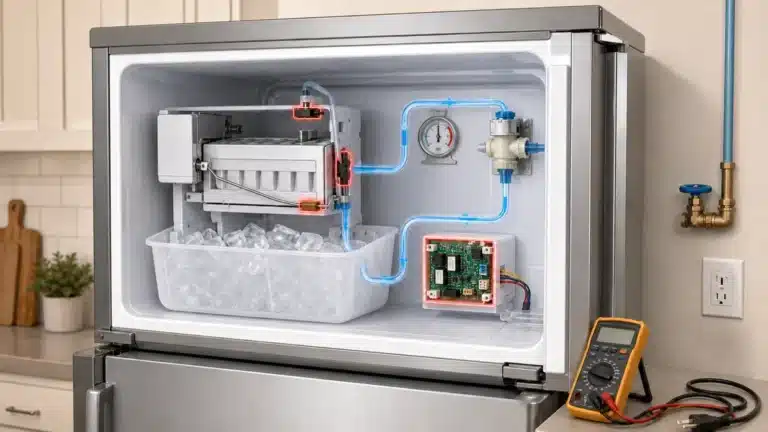
GE Refrigerator Error Codes: Causes & Fixes
1. Temperature Sensor (Thermistor) Failure
A faulty thermistor sends incorrect temperature readings to the control board, triggering error codes like FF (freezer fault) or CF (fresh food fault). This is one of the most common causes and the easiest part to replace yourself.
- Press and hold the Reset button (or unplug the refrigerator for 30 seconds) to clear the code and see if it returns.
- Locate the thermistor—typically clipped to an evaporator coil inside the freezer or fresh-food compartment.
- Disconnect the thermistor connector and test resistance with a multimeter; at room temperature (~70 °F) most GE thermistors read approximately 16,600 ohms. A reading far outside that range confirms failure.
- Replace the thermistor if it fails the resistance test.
2. Evaporator Fan Motor Not Running
Error codes such as 1F or 0F often indicate the freezer evaporator fan motor has stopped circulating cold air, causing temperatures to rise. Ice buildup around the fan or a burned-out motor are the usual culprits.
- Open the freezer and listen for fan noise; silence when the door switch is pressed suggests a fan problem.
- Remove the freezer back panel to access the evaporator fan assembly.
- Check for ice blocking the fan blades and defrost manually with a hair dryer if needed.
- Spin the fan blade by hand—it should turn freely. If it is stiff or the motor hums without spinning, replace the motor.
- Verify the door switch is activating properly; a stuck switch will keep the fan off whenever the door is sensed as open.
3. Defrost System Failure (Heater or Thermostat)
When the defrost heater or defrost thermostat fails, frost accumulates on the evaporator coils and the board logs a defrost-related fault code. Left uncorrected, airflow stops completely and both compartments warm up.
- Unplug the refrigerator and remove the freezer back panel to expose the evaporator coils.
- Manually defrost any heavy frost buildup using a hair dryer set to low heat—never use a sharp object.
- Test the defrost heater with a multimeter set to continuity; no continuity means the heater is open and must be replaced.
- Test the defrost thermostat (bi-metal thermostat) the same way while it is cold; it should show continuity when cold and open when warm.
- Replace whichever component failed.
4. Condenser Fan Motor Fault
The condenser fan draws air over the condenser coils at the back or bottom of the unit; if it fails the refrigerator overheats and may display a high-temperature error code. Dirty coils can contribute to or mimic this problem.
- Pull the refrigerator away from the wall and locate the condenser fan near the compressor at the bottom rear.
- Clean the condenser coils with a vacuum or coil brush—heavy dust can restrict airflow enough to trigger a fault.
- Power the unit back on and watch whether the fan runs when the compressor runs; if the compressor runs but the fan does not, the motor is likely failed.
- Test the fan motor with a multimeter for continuity; replace the motor if it reads open.
5. Ice Maker Error or Sensor Fault
GE French-door and side-by-side models may display ice maker-specific codes (such as CF on some displays or a blinking ice-maker LED) when the ice maker sensor or module malfunctions. This is usually isolated to ice-making and does not affect overall cooling.
- Turn the ice maker off using the on/off switch or arm, then back on to perform a reset.
- Check that the freezer temperature is at or below 0 °F (−18 °C); the ice maker will not cycle if the freezer is too warm.
- Inspect the water inlet valve for adequate water pressure (minimum 20 psi) and listen for a buzzing sound when the valve energizes.
- If the code persists after resetting, test the ice maker sensor/thermistor with a multimeter and replace it if out of spec.
- If the entire ice maker module is faulty, replace the module assembly.
6. Main Control Board Malfunction — Understanding GE Refrigerator Error Codes at the Source
When all sensors and components test good but error codes keep returning, the main control board itself may be misreading signals or have a failed relay. This is the most expensive repair and should only be attempted after ruling out all other causes.
- Unplug the refrigerator for at least 5 minutes to allow the board to fully reset, then restore power and monitor for the code.
- Inspect the board for visible damage: burnt spots, swollen capacitors, or corrosion on connectors.
- Check all wire harness connectors on the board for looseness or corrosion; reseat them firmly.
- Cross-reference the displayed code with GE’s official error-code reference at GE Appliances Support to confirm which circuit the board is flagging.
- If the board is confirmed faulty, replace it—note your exact model number from the label inside the fresh-food compartment door before ordering.
Frequently asked questions
How do I clear a GE refrigerator error code?
Unplug the refrigerator from the wall outlet and wait 30 seconds, then restore power. This performs a hard reset and clears stored codes. If the same code reappears within a few hours, the underlying fault is still present and needs to be repaired—simply clearing the code will not fix the problem.
What does the “FF” error code mean on a GE refrigerator?
“FF” stands for Freezer Fan fault and indicates the control board is not detecting proper operation of the freezer evaporator fan motor. Check whether ice is blocking the fan, confirm the door switch is working, and test the fan motor for continuity. Replace the motor or clear the ice obstruction to resolve the code.
Can I use my GE refrigerator while an error code is displayed?
It depends on the code. A sensor fault code may allow the unit to keep running in a default mode for a short period, but a defrost or fan fault will progressively warm your food. It is best to address error codes promptly—within 24 hours if possible—to protect stored food and prevent additional component damage.
Do all GE refrigerator models display error codes the same way?
No. Older GE models with basic mechanical controls may show faults only through symptom behavior, such as temperature swings, rather than a digital display. Newer models with electronic control panels display alphanumeric codes directly on the screen. French-door and Profile series models may also flash codes through LED sequences on the ice maker or dispenser panel rather than the main display.