LG Dryer Error Code D80 – Causes & Fixes
What causes the LG dryer error code D80?
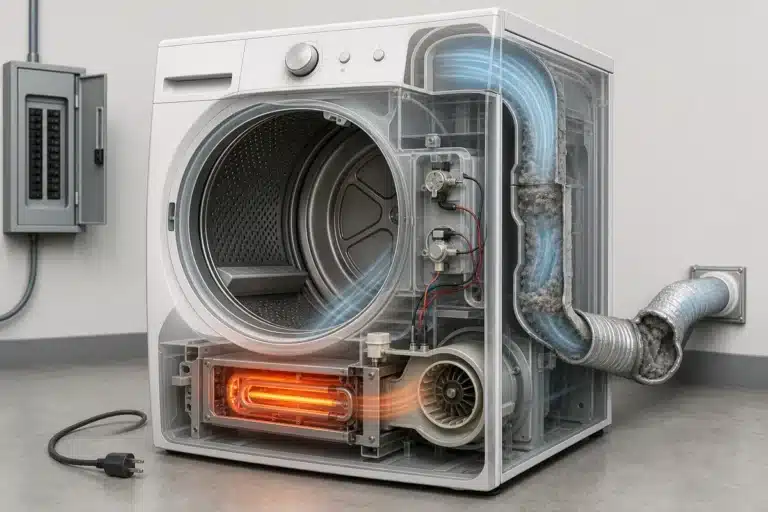
The D80 code is an airflow warning triggered by LG’s Flow Sense sensor system. It appears when the dryer detects that roughly 80% of normal exhaust airflow is blocked, most often by lint buildup somewhere in the venting path. Work through the causes below from easiest to hardest.
Cause 1: Clogged lint filter (most common)
A lint filter that hasn’t been cleaned recently is the single most common trigger. Even a thin layer of fabric-softener residue can cut airflow significantly.
- Pull the lint filter out of the door opening.
- Remove visible lint by hand, then rinse the filter under warm running water. If water beads up, scrub gently with a soft brush and dish soap to dissolve residue buildup.
- Let the filter dry completely before reinstalling it.
- Replace the filter, run a short cycle, and check whether the D80 code has cleared.
Cause 2: Blocked or kinked exhaust duct
A crushed, kinked, or lint-packed exhaust duct behind the dryer is the second leading cause of the lg dryer error code D80. Flexible foil or plastic ducts are especially prone to crushing when the dryer is pushed against the wall.
- Unplug the dryer and pull it away from the wall.
- Inspect the duct for sharp bends, kinks, or visible crushing. Straighten or reposition as needed.
- Disconnect the duct from the dryer’s exhaust port and from the wall.
- Use a dryer duct cleaning brush or a vacuum with a flexible hose to remove lint from inside the duct.
- Reconnect securely, push the dryer back (leaving at least 4 inches of clearance), and run a test cycle.
Cause 3: Blocked exterior vent cap
The exterior vent cap (where the duct exits your home) can accumulate lint, bird nests, or debris that partially or fully seals the flap shut.
- Go outside and locate the dryer’s exterior vent cap.
- Remove any visible debris, lint clumps, or nesting material by hand or with a brush.
- Open and close the flap manually to confirm it swings freely. A stuck or broken flap restricts airflow even when the duct is clean.
- Replace a damaged vent cap if the damper does not open freely.
- Return inside, run the dryer, and verify the code has cleared.
Cause 4: Duct run is too long or has too many elbows
Even a clean duct can restrict airflow if the total duct run exceeds LG’s maximum length recommendations or includes too many 90-degree elbows, which each reduce effective duct length.
- Measure the total length of your exhaust duct from the dryer to the exterior cap.
- Consult LG’s official support page or your dryer’s installation manual for the maximum duct-run length for your specific model (typically 64 ft for straight runs, minus 8 ft per 90° elbow).
- If the run is too long, shorten it by finding a more direct path to the exterior of your home.
- Reduce elbows where possible; use sweeping 45° bends instead of sharp 90° elbows to improve airflow.
Cause 5: Faulty airflow or exhaust thermistor
If all venting checks out but the D80 code persists, the Flow Sense sensor or exhaust thermistor that monitors airflow may be sending an incorrect signal to the control board.
- Unplug the dryer completely before working on internal components.
- Access the exhaust duct area inside the dryer (typically by removing the rear panel).
- Locate the thermistor or airflow sensor mounted on the exhaust duct housing. Check its wiring harness for loose connections, burns, or corrosion.
- Use a multimeter to test the thermistor for continuity; a faulty thermistor will show an open circuit or a reading far outside the normal range (consult your service manual).
- Replace the sensor if it tests out of range.
Cause 6: Worn or damaged blower wheel
A blower wheel caked with lint, cracked, or separating from its hub cannot move enough air through the drum, causing persistent airflow errors even with a clean duct system.
- Unplug the dryer and remove the front panel and drum to access the blower housing (location varies by model—check your service manual).
- Inspect the blower wheel for lint buildup, cracks, or wobble on the shaft.
- Clean off any lint with a brush or vacuum.
- Grasp the wheel and try to wiggle it on the motor shaft; if it moves more than slightly, the wheel is loose or the hub is damaged and the wheel should be replaced.
- Reassemble, restore power, and run a test cycle.
Frequently asked questions
Is it safe to keep using my dryer when it shows the D80 code?
No. Restricted airflow causes the dryer to overheat, which can damage components, shorten the appliance’s life, and — more seriously — increase the risk of a dryer fire. Address the code as soon as possible and do not run extended cycles until the venting is clear.
How do I reset the lg dryer error code D80 after fixing the vent?
On most LG dryers, the code clears automatically once airflow is restored. Start a normal dry cycle; if the venting issue is fully resolved, the code will not reappear. If it returns within a few minutes, there is still a restriction somewhere in the exhaust path.
How often should I clean my dryer’s exhaust duct to prevent the D80 code?
LG and most appliance-safety organizations recommend a full duct cleaning at least once a year for average use. Households that do laundry daily, have pets, or have duct runs longer than 25 feet should clean more frequently — every six months is a good target.
Can I use a leaf blower to clean the exhaust duct myself?
A leaf blower can dislodge loose lint but is not the most effective method and can push debris into wall cavities if the exterior cap is not opened or removed first. A purpose-made dryer duct cleaning brush kit combined with a shop vacuum is safer and more thorough. For very long or complex duct runs, consider hiring a professional duct-cleaning service.