Dryer Not Drying Clothes? Why It Takes So Long and How to Fix It

Start with a two-minute test. Run the dryer empty on a heated cycle for 5 minutes, then feel inside: Whirlpool says if it isn’t warm, “service might be needed.” If it’s warm, go through the airflow checks below; they fix most “takes forever to dry” problems.
Dryer not drying: match what you see
| What you notice | Most likely cause | Next step |
|---|---|---|
| Dryer is hot, clothes still damp, takes 2+ cycles | Blocked lint screen, duct or outside vent | Lint, duct, vent |
| Top of the dryer or laundry room gets very hot and humid | Exhaust can’t get out | Outside vent |
| Sensor cycle ends early, clothes damp | Dirty moisture sensor bars, small load, low dry level | Sensors |
| Towels damp, light clothes dry | Mixed load | Load |
| Clothes very wet from the washer | Washer not spinning properly | Washer spin |
| No heat at all | Heating problem, not airflow | Dryer not heating |
Follow the air
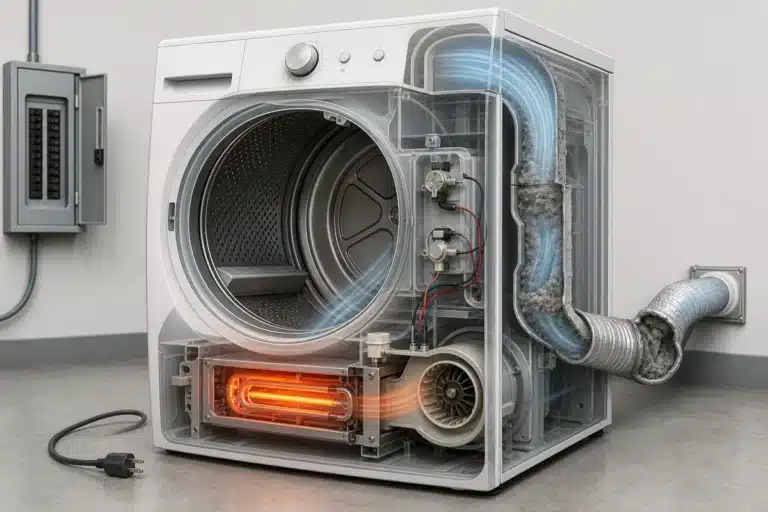
A dryer dries by blowing hot air through the clothes and pushing the wet air outside. Anything that slows that airflow slows drying, and also makes the dryer run hotter.
- Lint screen: clean it every load.
- Duct behind the dryer: not crushed or kinked.
- Vent run: not too long, few elbows.
- Outside flap: opens and blows hard when the dryer runs.
- Moisture sensor bars inside the drum: keep them clean.
- Load: not overfilled or soaking wet.
⚠️ Lint is a fire risk
The U.S. Fire Administration lists failure to clean as the leading factor in home clothes dryer fires. Unplug the dryer (and close the gas valve on a gas model) before pulling it out or disconnecting the duct. Don’t use plastic or foil accordion duct. If you smell burning, stop the dryer and don’t use it until it’s checked. If you smell gas, leave the home and call the gas utility from outside.
1. Clean the lint screen properly
Whirlpool recommends cleaning the lint screen “before every dryer load.” Dryer sheets and fabric softener also leave an invisible film that blocks air. Whirlpool’s sign: “The screen is probably clogged if lint falls off while the screen is in the dryer.” To deep-clean it, Whirlpool says to roll the lint off, wet both sides with hot water, scrub with a “nylon brush with hot water and liquid detergent,” rinse, and dry it thoroughly before reinstalling, every six months or more often if it clogs. The Department of Energy also suggests vacuuming the lint that collects in the slot under the screen.
2. Check the duct behind the dryer
Unplug the dryer and pull it out. The duct between the dryer and the wall should not be crushed, kinked or full of lint. Whirlpool says to use “rigid or semi-rigid metal venting” and to “Avoid plastic or foil accordion-style ducts.” Maytag specifies “4” diameter heavy metal exhaust vent material.” Disconnect the duct, vacuum it and the dryer’s outlet, and reconnect it with as little slack as possible.
3. Check the outside vent
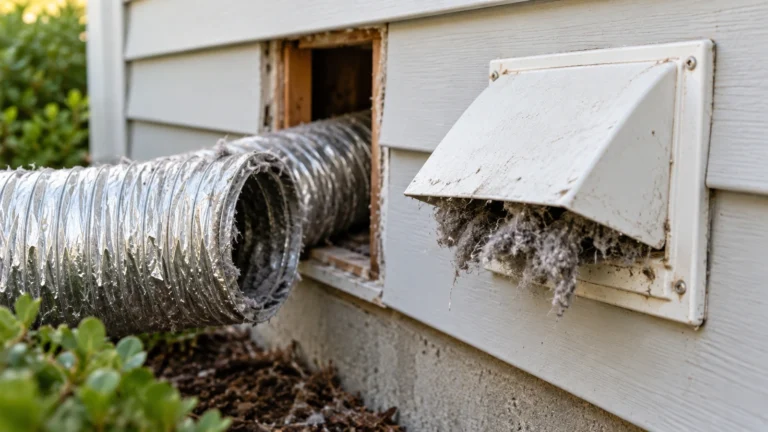
With the dryer running, go outside. Whirlpool: “confirm the vent hood flap opens freely during operation and clear any lint, debris, or nests.” Maytag’s test: run the dryer 5 to 10 minutes and hold your hand under the hood; “If the air movement is less than a hair dryer on high speed, clean the lint from the entire length of the system and the exhaust hood.” Maytag also says the hood should sit at least 12 inches above the ground or anything that could block it, like bushes or snow.
4. Make sure the vent isn’t too long
Whirlpool: “Many dryers perform best with total equivalent vent lengths under 35 feet; each 90-degree elbow adds resistance.” Samsung: “Every 90 degree turn reduces the maximum length by 6 feet.” Whirlpool’s guidance is no more than four 90-degree bends. Your installation manual has the exact limit for your model. A run through the attic or roof is a job for a professional vent cleaner. Whirlpool says the vent “must be cleaned every one to two years or as needed when dry performance has decreased.”
5. Check the load and the washer’s spin
- Size: Whirlpool: “Aim for the drum to be about one-half to three-quarters full so items can tumble freely.” Frigidaire: “If your dryer is overloaded or too empty, it will take longer to dry your clothes.”
- Mixed loads: Whirlpool: “Towels and heavy items can extend dry time when mixed with lightweight garments.” Dry them separately.
- Wet clothes: if clothes come out of the washer dripping, the washer isn’t spinning properly. Samsung points to its washer-won’t-spin guide; see our washer not spinning guide or washer not draining guide.
- Cold room: LG: “Do not operate your dryer at temperatures below 45°F (7°C).” Frigidaire notes that drying takes longer in high humidity.
6. Clean the moisture sensor bars
Sensor (automatic) cycles stop when two metal bars inside the drum detect dry clothes. Residue from dryer sheets fools them into stopping early. Frigidaire: “Remove the residue by wiping the moisture sensor bars with rubbing alcohol.” Samsung suggests a soft cloth and mild soap. LG says to clean them “once per month.” Small loads may not touch the sensors enough, so LG suggests a timed cycle for them.
7. Check the cycle and settings
LG notes that “Energy Saver is on by default for the Cotton/Normal cycle,” which dries without heat for much of the cycle; turn it off if you need faster drying. Samsung says to “Use a higher Dry Level” if sensor cycles end too soon. Air Dry or Fluff adds no heat. Whirlpool recommends an automatic cycle for most loads, and timed or higher heat for heavy items.
What fixing slow drying usually costs
| Job | Typical cost | Source |
|---|---|---|
| Dryer vent cleaning | $104 to $188 (average $145) | HomeAdvisor (June 2026) |
| Dryer vent cleaning | $100 to $200 (average $150) | Fixr (Jan 2025) |
| Dryer vent repair | $75 to $150 | Angi (Sept 2026) |
| Dryer vent replacement | $100 to $300 | Angi (Sept 2026) |
| Dryer repair, most jobs | $100 to $430 (average $180) | Angi (Sept 2026) |
When to call a professional
Call a dryer vent cleaner if the vent runs through walls, a ceiling or the roof, or the outside airflow stays weak after you clean what you can reach. Call an appliance technician if the 5-minute heat test is cold, if the dryer shuts off hot, or if a vent code (like LG’s d80 or Samsung’s hE) keeps coming back with a clean vent. Print the checklist.
Frequently asked questions
Why is my dryer hot but not drying clothes?
The wet air can’t get out: a clogged lint screen, crushed duct, long vent or stuck outside flap. Clean the lint screen and check the vent end to end.
Why does my dryer take two cycles to dry?
Usually restricted airflow, an overfilled or mixed load, or clothes coming out of the washer too wet. Dirty sensor bars can also end cycles early.
How do I know if my dryer vent is clogged?
Run the dryer and feel the outside vent. Maytag says if the airflow is weaker than a hair dryer on high, clean the whole system. Many dryers also show a vent warning: LG’s d80 or Samsung’s Vent Check.
How often should a dryer vent be cleaned?
Whirlpool says every one to two years, or sooner if drying slows down. Clean the lint screen every load.
Can dryer sheets cause slow drying?
Yes. They leave a film on the lint screen and moisture sensor bars. Wash the screen with hot water and detergent, and wipe the bars with rubbing alcohol.
Sources: Whirlpool: not drying or long dry times · Whirlpool: why your dryer isn’t drying · Whirlpool: cleaning the lint screen · Maytag: not drying · Maytag: long dry times · Samsung: clothes not dry · LG: reasons your dryer won’t dry · Frigidaire: long drying times · Energy Saver: laundry · U.S. Fire Administration: clothes dryer fires · HomeAdvisor: vent cleaning cost · Fixr: vent cleaning cost · Angi: dryer repair cost.
Updated October 23, 2026. Written and edited by Jordan Hale. Steps checked against Whirlpool, Maytag, Samsung, LG and Frigidaire support pages, Energy Saver and U.S. Fire Administration data; no hands-on test is claimed. Buttons and cycles vary by model, so follow your owner’s manual.