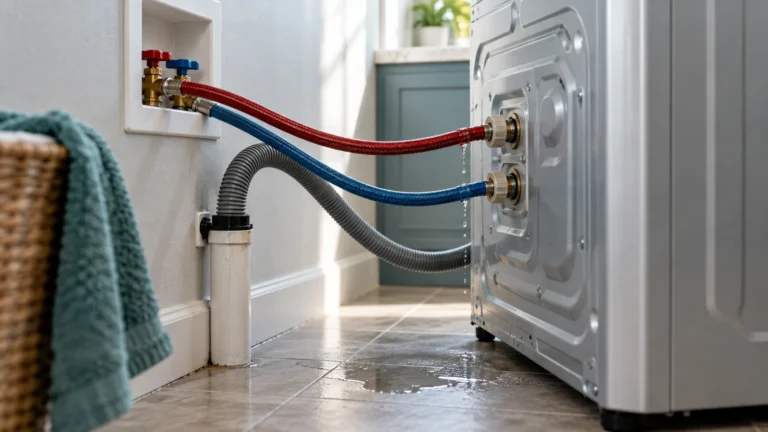
Washer Not Draining? Causes and Fixes for Any Brand

This guide works for every brand; Whirlpool, Maytag, GE, LG and Samsung differences are called out, and the code table links to our brand pages. If the drum is full of water now, read the caution box first.
Washer not draining: match what you see
| What you notice | Most likely cause | Next step |
|---|---|---|
| Water left in the drum after the washer was moved or pushed back | Kinked or crushed drain hose | Drain hose |
| Front loader drains slowly, smells musty | Clogged pump filter (coins, hair, lint) | Pump filter |
| Water backs up out of the standpipe or laundry sink | Clogged house drain | House drain |
| Lots of foam in the drum | Too much or non-HE detergent | Suds |
| Drains, but clothes come out soaking | Unbalanced load or slow spin cycle | Drain & Spin |
| Hums or makes no sound, tub stays full, everything clear | Drain pump fault | Call a technician |
⚠️ Caution: hot water, a lot of it, and power
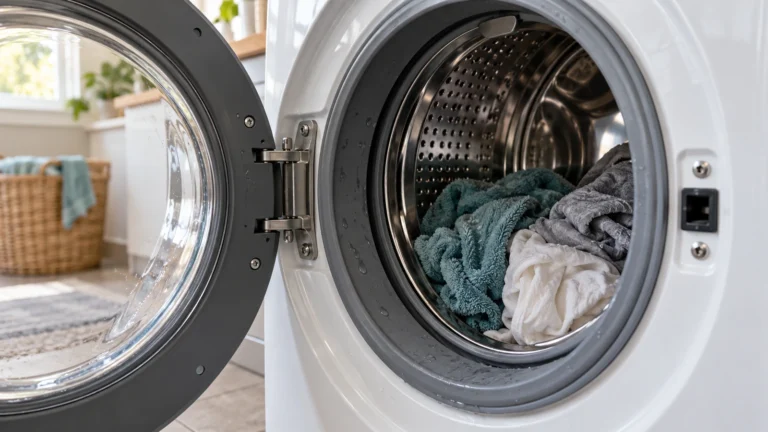
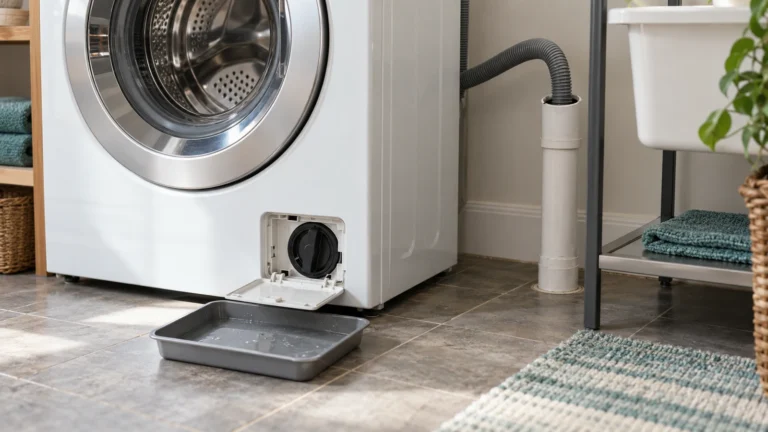
Unplug the washer before you open the pump filter or disconnect the drain hose. If you ran a hot or sanitize cycle, let the water cool first; LG warns “The water inside might still be hot.” Have towels and a shallow pan ready, because a front loader can hold several gallons. Don’t open the door of a front loader that’s full of water, and never force a locked door.
1. Check the drain hose
Pull the washer forward and look behind it. Whirlpool: “Make sure that the drain hose is not kinked or clogged.” GE adds: “Verify the drain hose is not kinked or crimped in any way.” Pushing the washer back against the wall is the usual way a hose gets flattened. Straighten it, and if you suspect a clog, unplug the washer, take the hose off the standpipe over a bucket and flush it.
2. Check the hose height and how it sits in the standpipe
- Height: Whirlpool and Maytag list the standpipe at “96” (244 cm) maximum and 30″ (76.2 cm) minimum.” LG says the hose “should be no less than 34″ and no higher than 96″ (8 ft) from the floor.” Samsung’s range is 18 to 96 inches. GE says most of its full-size washers can pump up to 8 feet.
- Depth: Samsung says the hose should go 6 to 8 inches into the standpipe, no more. GE warns about a hose “pushed too far down into the stand pipe or is taped to the stand pipe”; that can siphon water out or stop it draining.
- No airtight seal: don’t tape or seal the hose into the pipe. Use the U-shaped hose form or clip that came with the washer to hold it in place.
3. Clean the drain pump filter (most front loaders)
GE: “Most Front Load Washers have easy access to the pump filter on the front, bottom of the unit.” “Models without access in the front will require service.” Top loaders usually have no user-cleanable filter; Samsung says its top loaders “do not have a removable pump filter.” LG’s front-load steps:
- “Press the POWER button to turn the washing machine off and remove the plug from the outlet.”
- “Locate the service panel on the bottom-left corner of the unit and open it.”
- Unclip the small drain hose, remove its plug and “Drain the excess water into a short bucket or shallow pan.”
- “…twist the pump filter counterclockwise to remove from the washer.”
- “Clean the pump filter and filter opening with a soft-bristled brush and warm water.” Look for coins, hair ties and bra wires.
- Recap the drain hose and refit the filter securely.
Whirlpool says the filter “should be cleaned occasionally to keep the washer operating properly.” Samsung recommends about once a month. For brand detail, see LG OE code and Samsung ND code.
4. Rule out the house drain
GE’s test: take the drain hose out of the standpipe and pour in a quart of water. If it doesn’t drain away, the clog is in your plumbing; GE says “Household plumbing issues will require a plumber to resolve.” A laundry sink that fills while the washer drains points the same way. LG suggests a similar check: run a spin with the hose out of the drain and into a bucket; “If water drains well through the hose, the drain may be clogged.”
5. Cut back the detergent
Whirlpool: “Too much detergent can interfere with your washer’s ability to properly pump water and spin.” LG: “Our units are designed to be used with HE detergent only,” and too much HE detergent makes extra suds; the washer may add up to 2 hours to the cycle trying to clear them. LG suggests 2 tablespoons of regular HE detergent, or 1 tablespoon of a concentrated HE detergent. Run a rinse to clear foam before trying again.
6. Run Drain & Spin, and check the lid and load
Whirlpool: “You may need to run a Drain and Spin cycle if the water doesn’t automatically drain.” Make sure the lid or door is fully closed; Whirlpool notes that “The lid or door switch ensures that the washer operates only when the lid is securely closed.” If water drains but clothes stay soaking, the load may be unbalanced: “Washing a single bulky item or unevenly distributing laundry may prompt your machine to lower the spin speed.” Gentle and delicate cycles also spin slowly by design. GE notes that pauses of up to 3 minutes between cycle stages are normal on many models.
Drain error codes by brand
| Brand | Drain codes | Our guide |
|---|---|---|
| LG | OE (E03 or E21 on newer front loaders) | LG washer OE code |
| Samsung | ND, 5C, 5E, SC, SE | Samsung ND code |
| Whirlpool | See the code list | Whirlpool washer codes |
| GE | Po or flashing Rinse light (2015 and newer) | Follow the steps on this page |
What a washer drain repair usually costs
| Repair | Typical cost | Source |
|---|---|---|
| Drain pump repair | About $340 | HomeAdvisor (June 2026) |
| Pump replacement | $300 to $400 | Fixr (Jan 2025) |
| Washer repair, most jobs | $125 to $450 (average about $180) | HomeAdvisor (June 2026) |
| Diagnostic visit | $50 to $100 | Fixr (Jan 2025) |
A straightened hose or a cleaned filter costs nothing, so do those checks before booking a visit.
When to call a technician
Call if the hose, filter and house drain are clear and the washer still won’t drain, if it hums with a full tub (GE says that needs service), or if there’s no pump sound at all. Call a plumber if the standpipe won’t take a quart of water. Print the checklist.
Frequently asked questions
Why is my washer not draining?
Most often a kinked drain hose, a clogged pump filter (front loaders), a clogged house drain or too much detergent. If all are clear, the drain pump has likely failed.
How do I drain a washer that’s full of water?
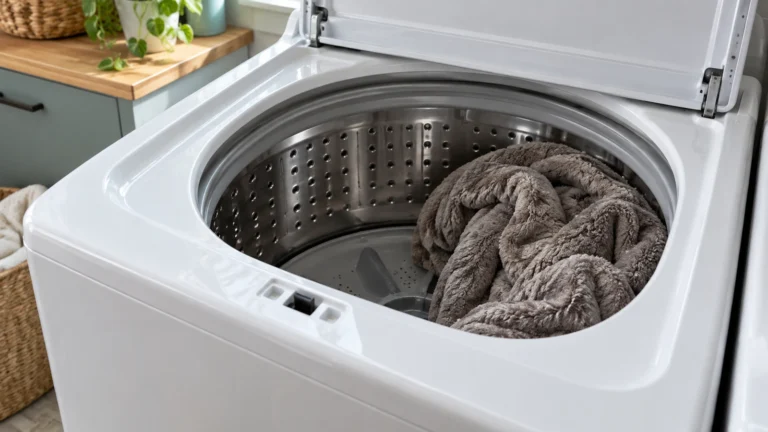
Run Drain & Spin first. On a front loader, drain it through the small hose behind the pump filter panel into a shallow pan. On a top loader, bail it out; don’t force the lid lock.
Can I unclog a washer drain myself?
Yes, if it’s the hose or the pump filter. A clog in the standpipe or house drain is a plumber’s job.
Why does my washer drain but clothes are still wet?
The spin is the issue: an unbalanced load, a gentle cycle with a slow spin, or excess suds. See our washer not spinning guide.
How high should a washer drain hose be?
Whirlpool and Maytag: standpipe 30 to 96 inches. LG: 34 to 96 inches from the floor. Samsung: 18 to 96 inches, with the hose 6 to 8 inches into the pipe.
Sources: Whirlpool: not draining or spinning · Whirlpool: washing machine not draining · Maytag: not draining or spinning · GE: washer won’t drain · GE: front load not draining · LG: washer not draining · LG: why water isn’t draining · Samsung: washer won’t drain · HomeAdvisor: washer repair cost · Fixr: washer repair cost.
Updated October 23, 2026. Written and edited by Jordan Hale. Steps checked against Whirlpool, Maytag, GE, LG and Samsung support pages; no hands-on test is claimed. Buttons vary by model, so follow your owner’s manual.