Dishwasher Not Draining? Causes, Fixes and How Much Water Is Normal
This guide works for every brand. Each step says where the major brands (Bosch, GE, Whirlpool, KitchenAid, Maytag, Frigidaire, LG and Samsung) differ, and links to our brand pages when you need model-specific steps or an error code.
Water in the bottom of the dishwasher: how much is normal?
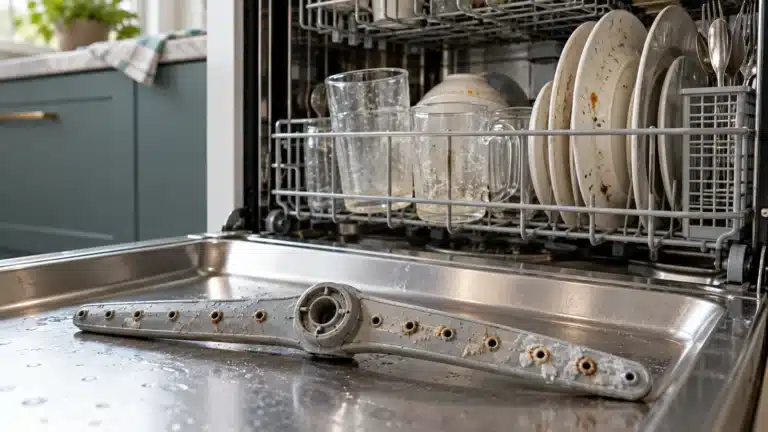
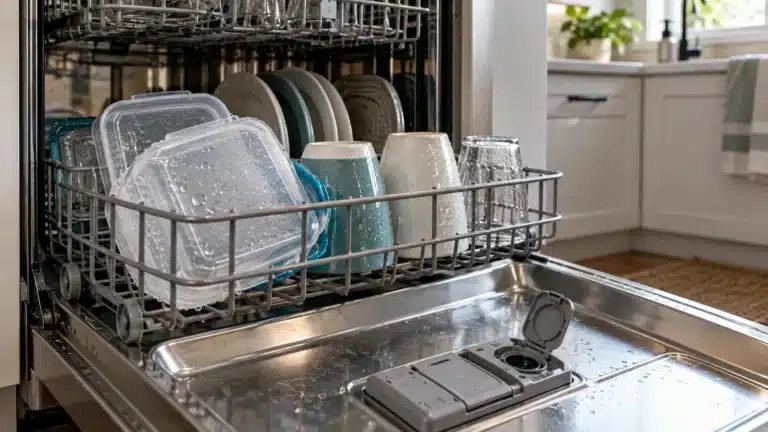
Some water after a cycle is normal on most dishwashers. It sits in the sump under the filter and is pumped out at the start of the next cycle.
- GE: “Water settled in the bottom of the dishwasher at the end of the wash cycle is normal.”
- KitchenAid and Whirlpool: “It is normal for there to be a small amount of standing water in the dishwasher filter area,” about halfway up the filter area. “This small amount of water is drained when you start your next cycle.”
- Bosch: up to about two cups is normal, because its condensation drying lets droplets run down into the base.
- Frigidaire: “It’s normal to see some water in the bottom of your dishwasher after a wash cycle is completed.”
When it isn’t normal: Maytag says “if you’re seeing an inch or more, it’s highly possible you have a clogged dishwasher.” Whirlpool adds that “Water slightly above the filter screen often indicates a partial restriction in the filter, sump, or hose.”
Dishwasher not draining: match what you see
| What you notice | Most likely cause | Next step |
|---|---|---|
| Dirty water over the filter, food bits in the bottom | Clogged filter | Clean the filter |
| Sink also drains slowly, or the disposal is full | Clog in the sink drain or disposal | Sink and disposal |
| Water spurts out of the chrome cap by the faucet | Clogged air gap | Air gap |
| Brand-new dishwasher or new disposal, never drained | Knockout plug not removed, or hose kinked | New install |
| Suds in the tub or on the floor | Hand dish soap or too much detergent | Suds |
| Humming, everything clear, still no drain | Drain pump or drain motor problem | Call a technician |
Where the water goes: the drain path
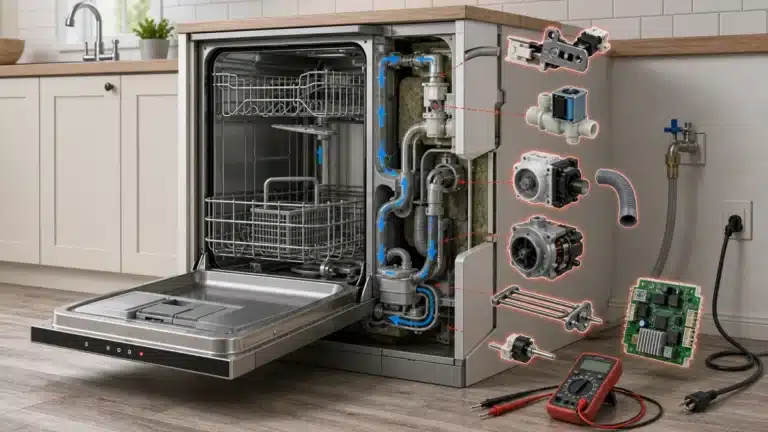
Water leaves the tub through the filter, gets pushed by the drain pump up through the drain hose to a high point under the counter, then down into the disposal or sink drain. A blockage at any numbered point stops the drain.
- Filter in the bottom of the tub: the most common cause. Clean it first.
- Drain pump under the filter: if everything else is clear, call a technician.
- High loop or air gap: keeps dirty sink water from flowing back into the dishwasher.
- Knockout plug: on a new disposal it blocks the dishwasher inlet until it’s removed.
- Drain hose: look for kinks, crushed spots or a clog at the sink end.
⚠️ Caution: power off, no drain cleaner
Switch off the dishwasher’s breaker (or unplug it) before reaching into the sump or under the sink, and switch off the garbage disposal too. Wear gloves: broken glass often ends up in the sump. GE says “Do not use drain cleaner in the dishwasher,” and Whirlpool says “Do not use drain-opening chemicals inside the dishwasher.” Bail standing water out with a cup and towels instead.
1. Clean the filter
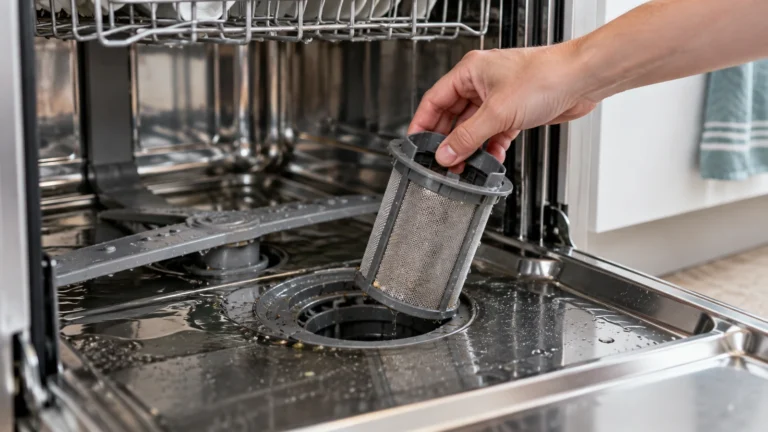
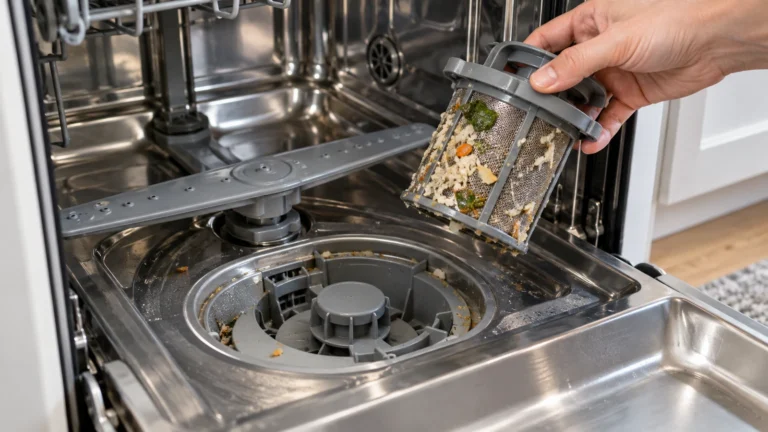
Whirlpool: “The most likely cause of dishwasher drainage concerns is a dirty filter.” Take out the lower rack, bail out the water, then remove the filter from the floor of the tub. Most twist counterclockwise to unlock. Rinse it under the tap with a soft brush, check the opening underneath for glass, bones or labels, and lock it back in place. Don’t use a wire brush or scouring pad; GE warns that scrubbing “can damage the filter.”
- GE: “Twist the Ultra Fine Filter counterclockwise and lift it to remove,” then the Fine filter.
- Frigidaire: turn the Cylinder Fine Filter counterclockwise, then lift out the Coarse Filter.
- Bosch: unlock the filter unit, unscrew the cylindrical filter, and line the arrows back up when refitting. See Bosch E24.
- KitchenAid and Whirlpool: clean the upper and lower filters “at least once a month.”
- LG: turn the mesh filter counterclockwise; LG recommends cleaning it after each load. See LG OE code.
2. Check the sink drain and disposal
Run the garbage disposal for a few seconds with cold water: a full disposal blocks the dishwasher’s outlet. Samsung’s test: run water in the sink for about 30 seconds. If the sink doesn’t drain either, the problem is in your house plumbing, not the dishwasher, and a plumber is the right call. GE also says to “Make sure the kitchen sink drain is not clogged.”
3. Straighten the drain hose
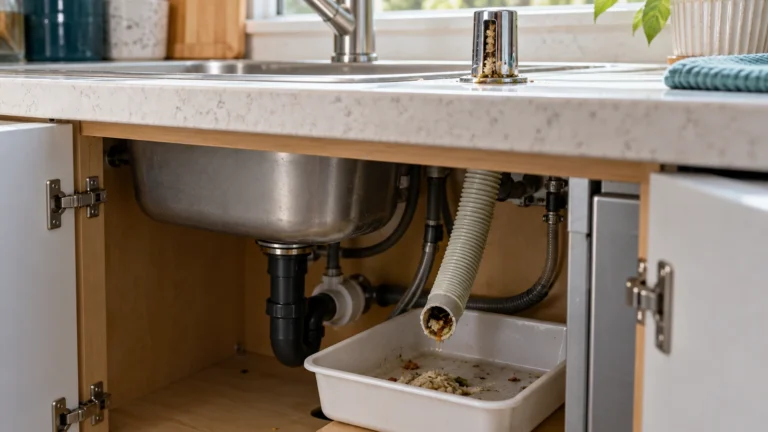
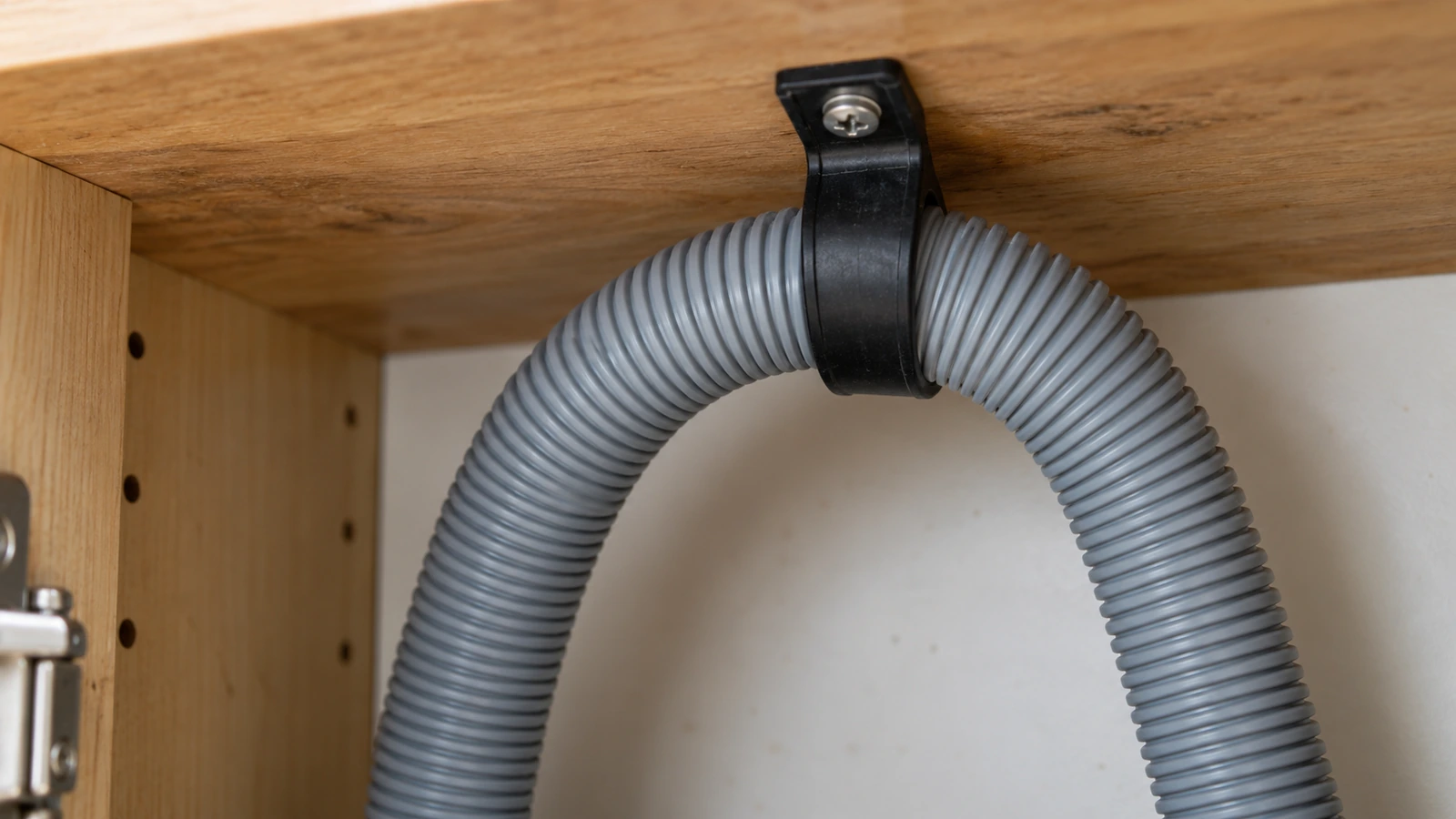
Open the sink cabinet and follow the ribbed drain hose from the dishwasher to the sink or disposal. GE: “Check the drain hose where it connects below the sink for a blockage or a kink in the hose.” LG notes that “heavy objects press against the drain hose under the sink.” Samsung says the most common cause after installation is a dishwasher “sitting on top of its own drain hose, pinching it shut.” To check for a clog, switch off the breaker, put a towel down, loosen the clamp where the hose meets the disposal or tailpiece, and flush it.
4. Clean the air gap and check the high loop
Many sinks have an air gap, the small chrome cap beside the faucet. GE: “Remove the chrome cover from the air gap,” “Unscrew the plastic cap,” then clear the debris. A bottle brush works. If there’s no air gap, the drain hose needs a high loop fastened under the counter. GE puts it “a minimum of 32 inches above the floor,” and Frigidaire also says 32 inches. A hose lying on the cabinet floor lets dirty sink water flow back into the tub.
5. New dishwasher or new garbage disposal
New disposals come with a plastic knockout plug in the dishwasher inlet. Until it’s knocked out, the dishwasher can’t drain. GE: “If a disposer was recently installed or replaced, make sure the drain plug inside the disposer was removed.” Frigidaire: “Ensure that the knockout plug has been removed from inside the food waste disposer inlet.” LG says the plug “must be removed by either an installer or plumber.” On a new dishwasher, LG adds that an OE code on the first cycle “indicates an installation issue with the drain hose.”
6. Make the dishwasher pump out
Once the blockage is cleared, cancel the cycle to start a drain. The steps differ by brand:
| Brand | How to cancel and drain |
|---|---|
| Bosch | “Press Reset 4 Sec. or Start Button for approximately 4 seconds.” It drains in about a minute. |
| Frigidaire | “Press and hold the Cancel button for 5–10 seconds.” |
| Whirlpool | Cancel the cycle; “The dishwasher starts a 2-minute drain (if needed).” |
| GE | Press Start/Reset and wait 2 minutes; if that fails, switch off the breaker for 30 seconds. |
| LG | Use CANCEL & DRAIN if your panel has it; otherwise “The first 45 seconds of any cycle is drain only.” |
| Samsung | On many models, press and hold Start for 3 seconds to cancel the cycle. |
Not draining but no blockage?
This is one of the most searched versions of the problem. If the filter, hose, air gap and sink are all clear:
- Suds: hand dish soap or too much detergent makes foam that the pump can’t move. GE’s fix is to add a gallon of cold water and drain, or sprinkle “several tablespoons of non-dairy coffee creamer over the suds.” Use only automatic dishwasher detergent.
- Interrupted cycle: if the door was opened or power was cut, the drain may not have run. Start and cancel a cycle.
- Pump cover loose or debris in the pump: on Bosch and some others, a small cover under the filter must be seated. See Bosch E24.
- Frozen drain line: Samsung notes a frozen line can stop draining; warm the cabinet and wait.
- Drain pump or motor: if you hear humming but no water moves with everything clear, the pump needs a technician.
Drain error codes by brand
| Brand | Drain codes | Our guide |
|---|---|---|
| Bosch | E24 (not draining), E22 (filter), E25 (pump) | Bosch E24 |
| LG | OE (drain error) | LG OE code |
| GE | C1, C2, C3 (“will not drain”), FTD | GE not draining |
| Frigidaire | i20 (not draining), i40 (clogged filter or sump) | Frigidaire not draining |
| Whirlpool | F9E1 (long drain), F9E2 (drain motor) | Whirlpool codes |
| Samsung | 5C, 5E, OC, OE | Follow the steps on this page |
What a dishwasher drain repair usually costs
| Repair | Typical cost | Source |
|---|---|---|
| Drainage issue repair (clog or pump) | $100 to $250 | Angi (Oct 2026) |
| Drain pump replacement | $150 to $400 | Fixr (Jan 2025) |
| Drain hose replacement | $75 to $130 | Angi (Oct 2026) |
| Dishwasher repair, typical range | $160 to $300 (average about $200) | HomeAdvisor (June 2026) |
| Diagnostic fee | $35 to $100 | HomeAdvisor (June 2026) |
When to call a technician
Call if the filter, sink, hose, air gap and disposal are all clear and water still sits above the filter, if you hear the pump hum without draining, or if a drain code returns after a reset. Call a plumber instead if the kitchen sink is also slow. Note your brand, model number (on a label around the door opening) and any code. Print the checklist.
Frequently asked questions
Why is there standing water in the bottom of my dishwasher?
A little under the filter is normal. Water over the filter usually means a clogged filter, a kinked hose, a full disposal, a clogged air gap or a new disposal’s knockout plug.
Can I force a dishwasher to drain?
Yes: cancel the cycle. Bosch: hold Start for about 4 seconds. Frigidaire: hold Cancel for 5 to 10 seconds. Whirlpool runs a 2-minute drain after you cancel. LG drains for the first 45 seconds of any cycle.
How do I know if my dishwasher drain hose is clogged?
Water slightly above the filter screen, a clean filter and a sink that drains fine all point to the hose. Switch off the breaker, disconnect it at the sink end and flush it.
Can I run the dishwasher with standing water in it?
Running a cancel or drain cycle is fine. Don’t keep running full cycles: if water is above the filter, fix the clog first.
Can I use Drano or vinegar to unclog my dishwasher?
No drain cleaner. GE and Whirlpool both say not to use drain chemicals in the dishwasher. Clean the filter and hose by hand instead.
How much does it cost to fix a dishwasher that won’t drain?
Often nothing: most clogs are in the filter, hose or disposal. A professional drain repair runs about $100 to $250 (Angi, Oct 2026); a new pump about $150 to $400.
Sources: GE: dishwasher not draining · GE: water in tub · GE: excess suds · KitchenAid: water in filter area · Whirlpool: unclog a dishwasher · Maytag: unclog a dishwasher · Frigidaire: not draining · Bosch: reset a cycle · LG: OE error · Samsung: dishwasher not draining · Angi: dishwasher repair cost · HomeAdvisor: dishwasher repair cost · Fixr: dishwasher repair cost.
Updated October 23, 2026. Written and edited by Jordan Hale. Steps checked against GE, Whirlpool, KitchenAid, Maytag, Frigidaire, Bosch, LG and Samsung support pages; no hands-on test is claimed. Buttons vary by model, so follow your owner’s manual.