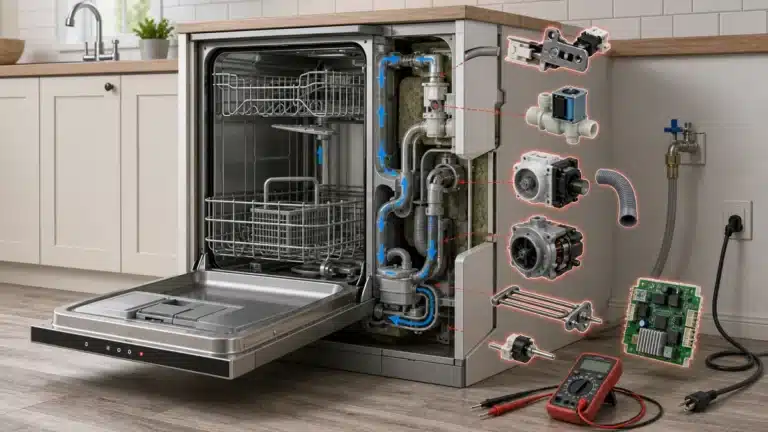
Frigidaire Dishwasher Not Draining – Fix It Fast
1. Clogged or Dirty Filter (Most Common Cause)
Food particles and grease accumulate in the filter basket at the bottom of the tub, restricting water flow until draining stops entirely. This is the first thing to check because it requires no tools and takes only a few minutes.
- Cancel any running cycle and open the dishwasher door.
- Remove the lower dish rack to access the tub floor.
- Twist the cylindrical filter counterclockwise and lift it out, then remove the flat mesh filter beneath it.
- Rinse both filter pieces under warm running water, scrubbing gently with a soft brush to remove grease and debris.
- Reinstall the filters, run a short rinse cycle, and check for proper draining.
2. Blocked or Kinked Drain Hose
The drain hose carries water from the pump to your sink drain or garbage disposal; a kink, clog, or improper installation can trap water in the tub. Check the hose before replacing any parts.
- Pull the dishwasher slightly forward (after shutting off power at the breaker) to access the hose along the back or side panel.
- Visually inspect the entire length of the hose for kinks or sharp bends and straighten any you find.
- Disconnect the hose at the sink drain or disposal end and check for an interior blockage using a flashlight.
- If the hose connects to a garbage disposal, confirm the disposal’s knock-out plug has been removed — a forgotten plug is a very common cause of no-drain issues.
- Clear any blockage, reconnect securely, restore power, and run a rinse cycle to test.
3. Clogged Drain Pump or Pump Screen
Broken glass, a cherry pit, or a build-up of debris can jam the drain pump impeller so it cannot push water out. You will often hear a humming sound if the motor is running but the impeller is blocked.
- Disconnect power at the breaker and turn off the water supply.
- Remove the lower rack, filter assembly, and the spray arm to expose the pump cover at the center of the tub floor.
- Unscrew or unclip the pump cover and look inside with a flashlight for debris or a foreign object.
- Use needle-nose pliers to remove any obstruction, then spin the impeller by hand to confirm it moves freely.
- Reassemble, restore power, and run a drain-only cycle to verify the fix.
4. Faulty Door Latch or Control Board Preventing the Drain Cycle
The dishwasher will not complete its drain cycle if the control board does not receive a proper signal, sometimes caused by a glitched cycle or a board fault. A hard reset often clears the problem instantly.
- Press and hold the Cancel/Drain button for 3 seconds to force a drain cycle.
- If that does not work, cut power to the dishwasher at the circuit breaker for 5 minutes, then restore power.
- Start a new short wash cycle and observe whether the unit drains at the end.
- If the display shows an error code, note it and look it up in your model’s manual on the Frigidaire official support page for specific guidance.
5. Defective Drain Solenoid or Drain Valve
Some Frigidaire models use a drain solenoid that opens the drain valve at the end of a cycle; if the solenoid fails, the valve stays closed and water sits in the tub.
- Disconnect power and locate the drain solenoid — it is typically mounted near the pump assembly at the base of the unit.
- Disconnect the wiring harness and test the solenoid with a multimeter set to resistance (Ohms); a reading of infinity (OL) means the solenoid is open-circuit and needs replacement.
- Manually actuate the solenoid plunger with a screwdriver to confirm it moves freely; a stuck plunger can sometimes be freed without replacement.
- Install a new solenoid if the old one tests faulty, reconnect wiring, restore power, and run a full cycle.
6. Standing Water Due to Air Gap or High-Loop Problem (Frigidaire Dishwasher Not Draining Fully)
Without a proper high loop or air gap in the drain hose installation, dirty water can siphon back into the tub after the cycle ends, making it appear the dishwasher never drained.
- Locate the drain hose where it exits the dishwasher and trace it to the sink cabinet.
- If there is no air gap fitting on the countertop, ensure the hose is routed up to the underside of the counter — at least as high as the tub — before going down to the drain connection. Secure it with a hose clamp or zip tie.
- If an air gap is installed, unscrew its decorative cap and inner cover and clean out any blockage in the cap with a small brush.
- Run a cycle and check that the tub is completely empty at the end.
Frequently asked questions
Why is my Frigidaire dishwasher not draining even after I cleaned the filter?
If cleaning the filter did not help, the next most likely culprits are a blocked drain hose, a jammed drain pump impeller, or a failed drain solenoid. Work through the causes above in order — the drain hose and pump account for the vast majority of cases where a clean filter does not solve the problem.
How do I force my Frigidaire dishwasher to drain?
Press and hold the Cancel/Drain button for approximately 3 seconds. The dishwasher should begin a drain-only sequence. If it does not respond, cut power at the breaker for 5 minutes and try again. This resets the control board and often clears a mid-cycle stall.
Is an inch of standing water in the bottom of my dishwasher normal?
A small amount of water — typically less than one cup — at the very bottom of the tub near the filter is normal on many Frigidaire models; it keeps the door seal from drying out. However, an inch or more of standing water after a completed cycle indicates a draining problem that should be investigated.
How much does it cost to fix a Frigidaire dishwasher that won’t drain?
DIY repairs are usually inexpensive: a replacement drain hose typically costs $15–$35, a drain pump $25–$60, and a drain solenoid $10–$30. Professional repair labor commonly runs $100–$200 depending on your area, on top of parts. In most cases, the total cost is well below that of a new appliance.