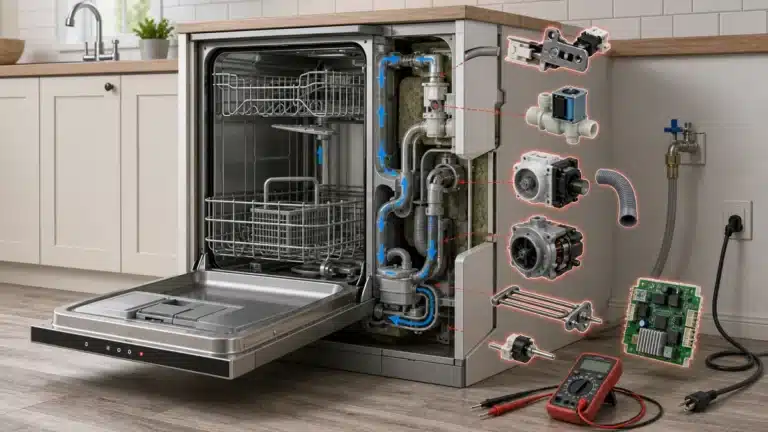
LG Dishwasher Error Codes: Causes & Fixes
1. OE Error Code – Drain Blockage (Most Common)
The OE code means the dishwasher cannot drain water within the expected time. A clogged filter, kinked drain hose, or blocked garbage disposal connection is usually the culprit.
- Cancel the cycle and open the door. Remove the lower rack.
- Twist out the cylindrical mesh filter and flat coarse filter from the tub floor. Rinse both under warm running water with a soft brush.
- Inspect the drain hose at the back of the unit for kinks or sharp bends; straighten as needed.
- If connected to a garbage disposal, confirm the knockout plug was removed during installation.
- Run a short drain-only cycle to confirm the code clears.
- If water still won’t drain, the drain pump may have failed.
2. IE Error Code – Water Supply Issue
The IE code fires when the dishwasher doesn’t detect enough incoming water within the fill time limit. Low water pressure, a closed supply valve, or a faulty water inlet valve are the usual causes.
- Check that the hot-water shut-off valve under the sink is fully open.
- Turn off the supply, disconnect the inlet hose, and inspect the inlet screen for sediment. Rinse it clean.
- Confirm household water pressure is at least 20 psi (a weak kitchen faucet flow suggests low pressure).
- Straighten any kinks in the supply hose.
- If water pressure and the valve are fine, test the water inlet valve with a multimeter for continuity. No continuity means it needs replacement.
3. AE Error Code – Leak Detected
The AE code means the leak sensor in the base pan has detected standing water underneath the dishwasher. Even a small drip from a door gasket or hose fitting can trigger it.
- Power off the dishwasher and shut off the water supply.
- Carefully tilt the unit back about 45° (with a helper) to drain water from the base pan.
- Inspect the door gasket all the way around for cracks, tears, or debris preventing a good seal. Clean or replace as needed.
- Check all internal hose connections and the sump area for signs of dripping.
- Look at the spray arm bearings and the tub-to-pump gasket for wear.
- Restore power only after the base pan is fully dry.
4. HE Error Code – Heating Problem
The HE code indicates the water isn’t reaching the target temperature during a wash or dry cycle, pointing to a failed heating element or a faulty thermistor (temperature sensor).
- Make sure the hot-water supply to your home is working and the water heater is set to at least 120 °F (49 °C).
- Run the kitchen hot-water tap until it’s hot before starting a cycle—this purges cold water from the supply line.
- Disconnect power and access the heating element at the bottom of the tub. Check for visible burn marks or breaks.
- Test the heating element with a multimeter. A reading outside the 20–30 Ω range typically indicates a faulty element.
- Test the thermistor for proper resistance change as temperature varies; replace if readings are erratic or open.
5. LE Error Code – Motor or Wiring Fault
The LE code signals that the wash motor has stalled or is drawing too much current, which can result from a seized motor, a wiring short, or a failed control board.
- Turn the dishwasher off and unplug it for 10–15 minutes. A soft reset sometimes clears a temporary motor overload.
- Check inside the tub for broken glass, a utensil, or debris jamming the spray arm or wash impeller—remove any obstructions.
- Spin the spray arms by hand; they should rotate freely. A stuck arm can back-pressure the pump and stall it.
- Inspect the wiring harness connector at the wash motor for corrosion or loose terminals.
- If the motor runs hot to the touch even after clearing obstructions, the wash motor itself has likely failed.
6. FE Error Code – Overfill / Faulty Fill Control (Most Advanced)
The FE code means the tub has received too much water, usually because the water inlet valve is stuck open or the control board is sending a continuous fill signal.
- Immediately shut off the water supply valve under the sink to prevent flooding.
- Cancel the cycle and allow the dishwasher to drain. Confirm the OE (drain) path is clear first.
- Inspect the water inlet valve for debris holding it open; flush or replace the valve.
- Check the float switch in the tub base—clean it and confirm it moves freely up and down.
- If the valve and float switch are both good, the control board may be sending a continuous fill command and will need professional evaluation.
Frequently asked questions
How do I reset my LG dishwasher to clear an error code?
Press and hold the Power button for 3–5 seconds to power the unit off, then unplug it (or trip its circuit breaker) for at least 10 minutes before restoring power. If the error returns immediately, the underlying fault has not been resolved and the relevant component should be inspected.
Where can I find the official list of LG dishwasher error codes for my model?
LG publishes error code definitions and owner’s manuals on their support site. Visit LG’s official support page, enter your model number, and download the owner’s manual—error codes are listed in the troubleshooting section at the back.
Why does my LG dishwasher show an error code mid-cycle instead of at the start?
Many faults—like a heating failure (HE) or drain timeout (OE)—only become detectable once the cycle reaches the phase that requires that function. The dishwasher monitors each stage continuously, so a code mid-cycle is normal and still points to the same component as if it appeared at startup.
Can I still use my LG dishwasher when an error code is displayed?
It depends on the code. An AE (leak) code means you should stop immediately to prevent water damage. An OE or IE code means the cycle cannot complete, so running it again wastes water and energy. Some informational alerts allow continued use, but it’s always safest to diagnose and fix the fault before the next wash.