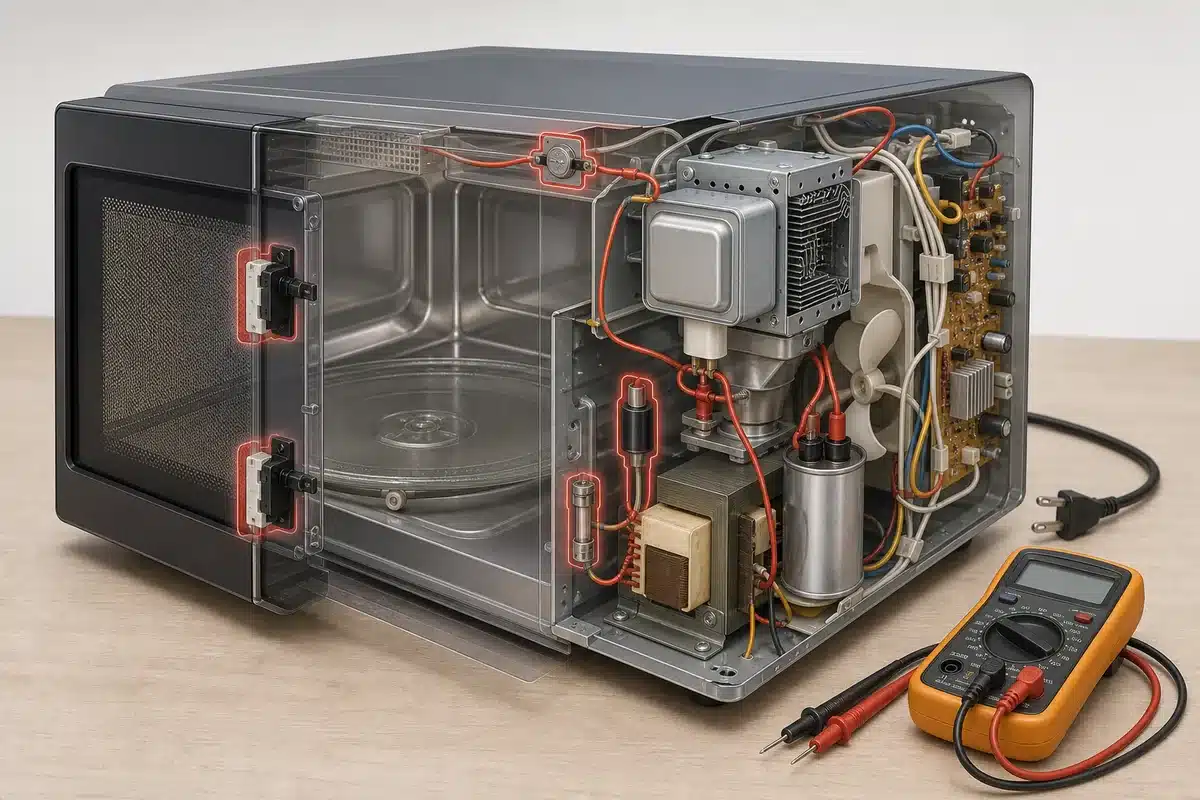
Why Is My Microwave Not Heating? Fix It Fast
1. Door Switch Not Engaging
Microwaves have two or three interlock door switches that must all close properly before the unit will generate heat. A single failed switch silently disables the heating circuit while leaving the lights and turntable working normally.
- Unplug the microwave from the wall outlet.
- Open and firmly close the door, listening for a solid click from each latch hook.
- Inspect the door hooks and the plastic latch tabs on the cabinet — look for cracks or bent hooks.
- If a hook or tab is broken, replacing the door latch assembly usually restores full function.
- If the latches look fine, use a multimeter set to continuity mode to test each door switch: a good switch clicks between open and closed circuit as you press its plunger.
- Replace any switch that shows no continuity change.
2. Blown Internal Fuse
Most microwaves contain a ceramic thermal fuse or a line fuse that blows to protect the appliance from power surges or overheating. A blown fuse cuts all power to the magnetron circuit, preventing any heating.
- Unplug the microwave and wait at least two minutes.
- Remove the outer cabinet (typically 4–6 screws on the back panel).
- Warning: Do NOT touch the large capacitor or any high-voltage components — it can hold a lethal charge even when unplugged.
- Locate the ceramic fuse near the power input board or the high-voltage transformer.
- Test the fuse with a multimeter on continuity mode — a blown fuse reads no continuity.
- Replace with a fuse of identical amperage and voltage rating.
3. Faulty High-Voltage Diode
The high-voltage diode converts the transformer’s AC output to DC power that feeds the magnetron. When it fails, the magnetron receives no usable power and the microwave runs silently without heating — sometimes producing a loud hum.
- Unplug the microwave and discharge the high-voltage capacitor using an insulated screwdriver or a purpose-made capacitor discharge tool before touching anything inside.
- Locate the diode — it is typically connected between the capacitor and the chassis ground.
- Disconnect the diode and test it with a multimeter: a good diode shows continuity in one direction only. A burned or shorted diode will show continuity in both directions or none at all.
- Replace the diode if it fails the test.
4. Defective High-Voltage Capacitor
The high-voltage capacitor works alongside the diode to double the transformer’s output voltage to the magnetron. A shorted or open capacitor disables the entire high-voltage circuit, stopping all heating.
- Unplug the microwave and wait at least 10 minutes — this capacitor stores potentially lethal voltage (up to 2,100 V) even after the unit is unplugged.
- Discharge the capacitor safely using an insulated capacitor discharge tool or a 10,000-ohm, 10-watt resistor held across the terminals with insulated probes.
- Once discharged and confirmed safe with a multimeter reading of 0 V, disconnect the capacitor terminals.
- Test with a multimeter on capacitance mode — replace if the reading is far below the rated capacitance printed on the body, or if it shows a short circuit (near-zero resistance on resistance mode).
5. Failed Magnetron — Why Is My Microwave Not Heating Even After Other Fixes?
The magnetron is the core component that generates the microwave energy responsible for heating food. It is a high-wear part that can burn out after years of use, and its failure is a definitive cause of zero heat output.
- Unplug the microwave and fully discharge the capacitor as described above.
- Locate the magnetron — it is the large cylindrical component with antenna fins mounted on the waveguide cover cavity.
- Inspect the magnetron’s filament terminals: use a multimeter on resistance mode to check for continuity across the two filament terminals (a good magnetron reads a very low resistance, typically 1–3 ohms).
- Also test each terminal to the magnetron’s metal casing — the reading should be infinite (open circuit). Any continuity to the casing indicates a shorted magnetron.
- If the magnetron fails either test, it must be replaced.
- Note: Due to the cost of a magnetron, compare the repair cost against the price of a new microwave before proceeding.
6. Faulty Control Board or Thermal Cut-Out
The main control board (also called the PCB) sends the signal to energize the high-voltage circuit; if it malfunctions, it can prevent heating while all other functions appear normal. A thermal cut-out fuse on the magnetron body also trips when the unit overheats, halting heating until it resets or is replaced.
- Unplug the microwave and discharge the capacitor before opening the cabinet.
- Locate the thermal cut-out, which is a small disc-shaped component mounted directly on the magnetron body or the cavity wall.
- Test the thermal cut-out with a multimeter on continuity mode — it should show continuity at room temperature. No continuity means it has tripped permanently and must be replaced.
- If the thermal cut-out is good, visually inspect the control board for burned traces, cracked solder joints, or bulging capacitors.
- For confirmed control board failure, replacement is typically the only repair option for non-commercial units.
- For official guidance on your specific model, consult iFixit’s microwave repair guides for teardown diagrams and verified repair procedures.
Frequently asked questions
Is it safe to repair a microwave myself?
Basic repairs like replacing a door switch or line fuse are manageable for a careful DIYer. However, the high-voltage capacitor stores a potentially lethal charge even when the unit is unplugged. Always discharge the capacitor completely and verify 0 V with a multimeter before touching any internal components. If you are unsure at any step, stop and call a professional.
My microwave turns on and the turntable spins, but there’s no heat — what does that mean?
This specific symptom — everything working except heating — almost always points to a fault in the high-voltage circuit: most commonly a failed door switch, a burned-out high-voltage diode, or a blown line fuse. Start with the door switch and fuse since they are the cheapest and easiest to check and replace.
How do I know if my magnetron has failed?
Signs of a failed magnetron include the microwave running with zero heat, a loud buzzing or burning smell during operation, or visible burn marks inside the cavity near the waveguide cover. You can confirm failure with a continuity test of the magnetron filament (should show 1–3 ohms) and a chassis short test (should show infinite resistance between terminals and the casing).
Is it worth repairing a microwave that isn’t heating, or should I just replace it?
For low-cost fixes — a door switch, diode, fuse, or thermal cut-out — repair almost always makes financial sense, as parts typically cost under $20. For a magnetron or control board replacement, compare the total repair cost (parts plus labor) against the price of a new unit. If repair costs exceed 50% of replacement cost, buying new is usually the smarter choice.
One Comment