Microwave Not Heating? Causes & Fixes (Step-by-Step)
1. Door Interlock Switch Failure (Most Common)
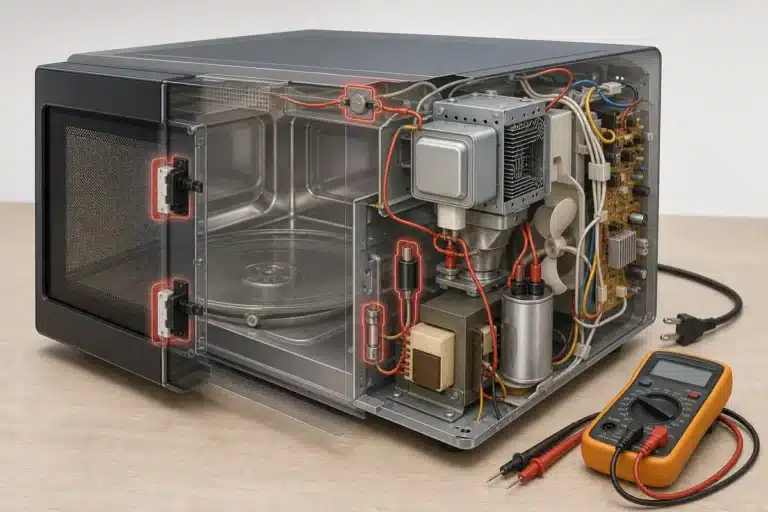
Microwaves have two or three door interlock switches that must all close correctly before heating begins. A single faulty switch will stop the magnetron from firing even though the display and turntable may still work.
- Unplug the microwave from the wall before doing anything else.
- Open and firmly close the door; listen for a solid click from each latch hook.
- Inspect the door hooks and the switch actuators in the cabinet frame for visible cracks or bent plastic.
- If a hook is broken, the door latch assembly needs replacement.
- To test the switches themselves, remove the outer cabinet (after unplugging) and use a multimeter set to continuity mode on each switch. A good switch clicks and shows continuity when pressed; replace any that don’t.
2. Blown Thermal Fuse or Cavity Fuse
A thermal fuse is a one-shot safety device that permanently opens if the microwave overheats, cutting power to the high-voltage circuit. Unlike a house fuse, it cannot be reset—it must be replaced.
- Unplug the microwave and remove the outer cabinet.
- Warning: The high-voltage capacitor can store a lethal charge even when unplugged. Do not touch any components inside until you have discharged the capacitor through a 10 kΩ, 10-watt resistor held across its terminals.
- Locate the thermal fuse (usually a small cylindrical component on or near the magnetron or oven cavity).
- Set your multimeter to continuity mode and probe both ends of the fuse. No continuity means the fuse is blown.
- Replace it with a fuse of the same voltage and temperature rating (check the markings on the old fuse).
3. Faulty High-Voltage Diode
The high-voltage diode converts AC power to DC for the magnetron; a shorted or open diode is a very common reason a microwave not heating will still seem to run normally otherwise. A failed diode often produces a loud buzzing or humming during operation.
- Unplug the microwave, remove the cabinet, and discharge the capacitor as described above before touching any components.
- Locate the high-voltage diode—it connects the capacitor to the chassis ground and is typically near the magnetron.
- Disconnect the diode and test it with a multimeter on the diode setting: it should show continuity in one direction only. Continuity in both directions (short) or neither direction (open) means it has failed.
- Install a new diode with the same voltage rating. Polarity matters—note the orientation before removal.
4. Failed High-Voltage Capacitor
The high-voltage capacitor works with the diode to double the voltage sent to the magnetron; a shorted capacitor can blow the diode or fuse, while an open capacitor starves the magnetron of power.
- Unplug the microwave and remove the outer cabinet.
- Discharge the capacitor first using a 10 kΩ resistor—never short it directly, as the spark can damage components.
- Disconnect the capacitor leads and test with a multimeter on the capacitance setting (if available) or use the resistance setting: the reading should climb from low to high as it charges from the meter. A reading of zero (short) or no movement (open) indicates failure.
- Replace with a capacitor of the same capacitance (µF) and voltage rating.
5. Defective Magnetron
The magnetron is the vacuum tube that actually generates the microwave energy; when it fails the oven runs silently with no heating at all, and replacement is the only fix.
- Unplug the microwave, remove the cabinet, and fully discharge the capacitor.
- Check the magnetron’s filament leads with a multimeter on the continuity setting: you should read very low resistance (near zero ohms) across the filament terminals. An open filament (no continuity) confirms failure.
- Also check that neither filament terminal reads continuity to the magnetron’s outer case (chassis)—if it does, the magnetron is shorted internally.
- Consider the age and cost of the unit before replacing the magnetron; on older or budget microwaves the part cost may approach the price of a new appliance.
- For detailed safety guidance on magnetron handling, see the U.S. EPA microwave radiation safety page.
6. Faulty Main Control Board
If all high-voltage components test good, the main control board may be failing to send the “cook” signal to the high-voltage circuit, though this is the least common cause of a microwave not heating.
- Unplug the microwave and inspect the control board (located behind the control panel) for visibly burned traces, swollen capacitors, or scorch marks.
- Check that the ribbon cables and wire harness connectors to the board are fully seated.
- If physical damage is visible, replace the board. If no damage is visible, consider having a technician confirm the diagnosis before purchasing an expensive board.
Frequently asked questions
Is it safe to repair a microwave myself?
Basic checks like inspecting the door latch or testing a fuse are generally safe if the unit is unplugged and you follow the steps carefully. However, the high-voltage capacitor inside a microwave can store a lethal charge of around 2,100 volts even after the unit is unplugged. Always discharge the capacitor through a proper resistor before touching any internal components, and if you are unsure, call a qualified appliance technician.
Why does my microwave run but produce no heat?
When the display, light, and turntable all work but there is no heat, the problem is almost always inside the high-voltage circuit—most commonly a failed door interlock switch, a blown thermal fuse, a bad high-voltage diode, or a burned-out magnetron. The control electronics are working fine; it’s the microwave-generating side of the circuit that has lost power or function.
How long should a microwave last before I consider replacing it instead of repairing?
Most countertop microwaves are designed for roughly 7–10 years of normal use. If your unit is already 8 or more years old and the repair involves an expensive part like the magnetron or control board, replacement often makes more financial sense. As a general rule, if the repair cost exceeds 50% of the price of a comparable new model, consider replacing it.
Could a tripped circuit breaker or low voltage cause my microwave to stop heating?
Yes. Microwaves require a dedicated 15–20 amp circuit; if the circuit is shared with other high-draw appliances, the breaker may trip or voltage may sag, causing the microwave to run but not heat properly. Check your breaker panel, make sure the outlet is supplying full voltage (ideally with a multimeter or by plugging in another appliance), and avoid using a long or lightweight extension cord, which can cause a significant voltage drop.
One Comment