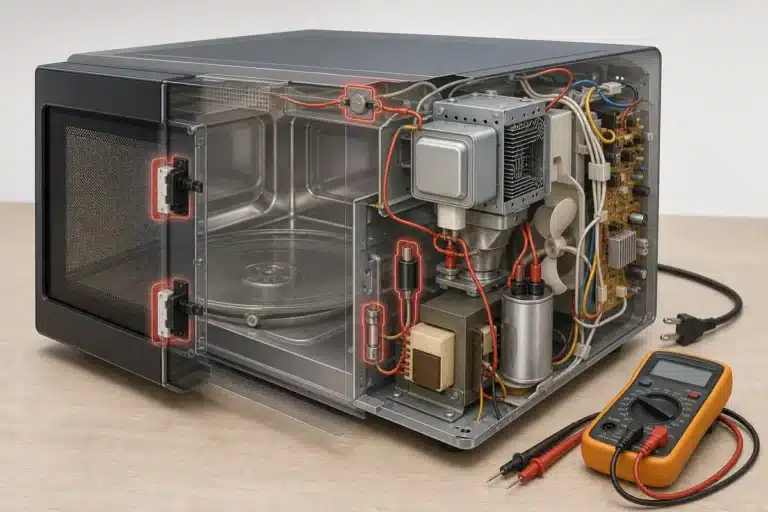
LG Microwave Not Heating – Causes & Fixes
1. Blown Door Interlock Fuse
The ceramic line fuse or thermal fuse protects the microwave’s circuits when a door switch fault occurs. If this fuse has blown, the unit may appear to run but produce no heat at all.
- Unplug the microwave from the wall outlet and wait at least 2 minutes.
- Remove the outer cabinet (typically 4–6 Phillips screws on the back panel).
- Locate the ceramic fuse near the power input—it sits in a small inline holder.
- Use a multimeter set to continuity mode; place probes on each fuse terminal.
- No beep or infinite resistance means the fuse is blown—replace it with one of identical amperage and voltage rating.
- Reassemble, plug in, and test with a cup of water for 1 minute.
2. Faulty Door Interlock Switch
LG microwaves use two or three door interlock switches that must all close properly before power reaches the magnetron. A failed switch tricks the appliance into thinking the door is open.
- Unplug the unit and remove the cabinet as described above.
- Open and close the door slowly while watching the small plastic latch hooks—any broken hook indicates a bad switch.
- Disconnect each switch’s wiring harness and test each switch with a multimeter for continuity when pressed (closed) and no continuity when released (open).
- Replace any switch that fails the continuity test.
- Note: a shorted secondary interlock switch often blows the line fuse simultaneously—replace both if the fuse was already blown.
3. Defective High-Voltage Diode
The high-voltage diode converts AC current to DC for the magnetron. When it shorts or opens, the magnetron receives no usable power and the microwave stops heating—sometimes accompanied by a loud humming noise.
- Unplug and discharge the high-voltage capacitor before touching anything: use a well-insulated screwdriver blade across the capacitor terminals (or a resistor discharge tool) until no spark occurs.
- Locate the diode—it connects the high-voltage capacitor to chassis ground.
- Disconnect the diode and test with a multimeter on the diode setting: you should see continuity in one direction and none in the other. A reading of continuity in both directions (or none at all) confirms failure.
- Install a replacement diode with matching voltage and current ratings.
4. Failed High-Voltage Capacitor
The high-voltage capacitor works with the diode to double the line voltage supplied to the magnetron. A failed capacitor means insufficient power reaches the magnetron, resulting in no heat.
- Unplug the appliance and discharge the capacitor as described in step 3 above—capacitors can hold a lethal charge even when unplugged.
- Remove the capacitor’s wire leads and test with a multimeter set to capacitance; compare the reading to the value printed on the capacitor body (typically 0.9–1.05 µF).
- Also check resistance across the terminals: a healthy capacitor will show rising resistance; a shorted one reads near zero ohms.
- Replace with a capacitor of identical µF rating and voltage rating (usually 2100 VAC).
5. Burned-Out Magnetron – The Core of LG Microwave Not Heating Issues
The magnetron is the component that generates microwave energy. When it burns out—often after years of use or from running the appliance empty—no amount of power-supply repair will restore heating.
- Unplug and discharge the capacitor before proceeding.
- Inspect the magnetron’s antenna (the small rod protruding into the waveguide) for burn marks, cracks, or corrosion.
- Test the magnetron filament terminals with a multimeter set to resistance: you should see a very low resistance (around 0–1 Ω). Open-circuit (infinite resistance) means a burned filament.
- Also test from each filament terminal to the magnetron chassis—you should see no continuity. Any reading indicates a shorted magnetron.
- Replace the magnetron if either test fails. Given the cost of a magnetron, compare it against the appliance’s age and price before proceeding.
6. Faulty Control Board or Inverter Board
On inverter-based LG models, a failed inverter board or main control board can cut power to the high-voltage circuit entirely. Visible burn marks or bulging components on the board are telltale signs.
- Unplug the unit and remove the cabinet.
- Visually inspect both the main control board and (if present) the inverter board for burned traces, cracked solder joints, or swollen capacitors.
- If damage is visible, the board should be replaced—board-level soldering repairs are not recommended for high-voltage circuits.
- Consult the LG official support page to look up your model’s wiring diagram before ordering a replacement board.
- Install the new board, reconnect all harnesses in the same orientation, and test.
Frequently asked questions
Why does my LG microwave run but produce no heat?
When a microwave runs (turntable spins, light comes on, timer counts down) but generates no heat, the most likely culprits are a failed high-voltage diode, a blown high-voltage capacitor, or a burned-out magnetron. These components form the high-voltage circuit that actually produces microwave energy. Start by testing the diode first—it is the cheapest and most commonly failed part in this scenario.
Is it safe to repair a microwave myself?
Basic repairs like replacing a door switch or line fuse are manageable for a careful DIYer. However, the high-voltage capacitor can store a lethal charge (up to 2,100 V) even after the unit is unplugged. Always discharge the capacitor before touching internal components, and if you are not comfortable working around high-voltage parts, hire a qualified appliance technician instead.
How much does it cost to fix an LG microwave that won’t heat?
Repair costs vary widely by cause. A door fuse or diode replacement typically costs $10–$30 in parts, making it very economical. A magnetron replacement can cost $50–$150 or more in parts alone, plus labor if you use a technician. For older or lower-end models, it may be more cost-effective to replace the appliance rather than invest in a magnetron or control board repair.
How do I know if my LG microwave’s magnetron is bad?
Signs of a bad magnetron include: the microwave runs but food remains completely cold, a loud buzzing or humming during operation, a burning smell, or visible burn marks on the magnetron antenna inside the waveguide cavity. You can confirm a failed magnetron by testing its filament with a multimeter—you should read near-zero resistance across the filament terminals. An open-circuit (infinite) reading confirms the magnetron has failed and needs replacement.